
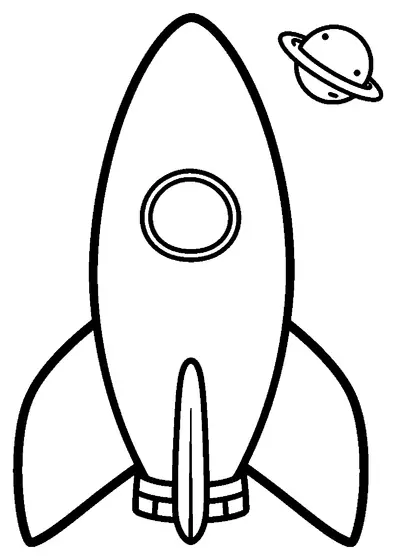
Moon Rocket from the Side
A classic lunar launch vehicle features a long cylindrical body, a rounded viewing window, and wide stabilizing fins on its lower section.

A4 format (landscape), black outlines on a white background · for home and classroom use
All coloring pages: Planet and Solar System Coloring Pages
Similar coloring pages: Planet and Solar System Coloring Pages



What else can you print? Free, no account needed
Custom Name Coloring Pages
Enter your child's name to generate a custom coloring page featuring large outline letters to color and decorate.
Open generator →Connect the Dots Generator
Eight connect-the-dots pictures across three difficulty levels. Features faint outline guides for younger children and dots only for older kids.
Open generator →Printables
Worksheets, tracing lines, mazes and dot-to-dots in A4.
Browse printables →
Side View of a Lunar Launch Vehicle
This vessel illustrates the essential external components of a spacecraft intended for long-distance spaceflight. The side perspective highlights the main fuselage, the small observation window near the upper section, and the wide fins attached near the base that keep the vehicle stable during early flight.
Scientific Facts About Lunar Rockets
Navigating to Earth's natural satellite requires immense velocity to overcome gravitational forces. Rockets designed for moon missions carry enormous amounts of propellant, which accounts for the vast majority of their total weight before takeoff. The distinctive aerodynamic shape helps minimize air resistance while passing through the denser layers of the atmosphere.
Authentic Colors of Lunar Spacecraft
- Fuselage: White or off-white heat-resistant tiles
- Porthole frame: Dark gray or polished aluminum
- Fins: Black or dark gray thermal coating
- Lower nozzle: Metallic gray or dark alloy