
Mars Rover Viewed from the Front
An autonomous scientific rover travels across red dust to gather data on the Martian environment.

A4 format (portrait), black outlines on a white background · for home and classroom use
All coloring pages: Planet and Solar System Coloring Pages
Similar coloring pages: Planet and Solar System Coloring Pages



What else can you print? Free, no account needed
Custom Name Coloring Pages
Enter your child's name to generate a custom coloring page featuring large outline letters to color and decorate.
Open generator →Connect the Dots Generator
Eight connect-the-dots pictures across three difficulty levels. Features faint outline guides for younger children and dots only for older kids.
Open generator →Printables
Worksheets, tracing lines, mazes and dot-to-dots in A4.
Browse printables →
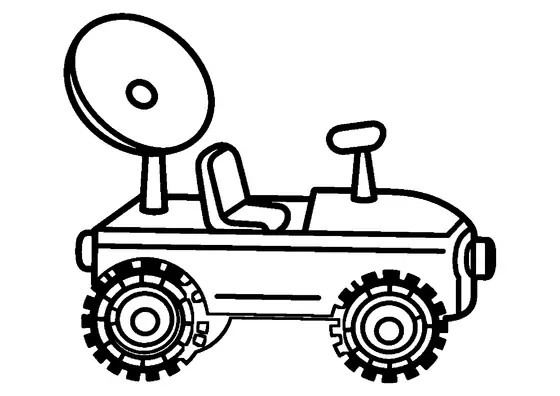
Mars Rover with Camera Mast and Solar Panels
Robotic rovers on Mars navigate dry terrain to analyze rocks, soil, and atmospheric conditions. This robotic vehicle features wide wheels engineered to cross loose sand, a tall camera mast for elevated viewing, and a solar panel mounted to capture sunlight. Operating millions of miles away from human assistance, these machines rely on solar energy and automated systems.
Powering Robotic Explorers on Mars
Martian dust storms can cover solar panels in fine silt, reducing the amount of power the rover receives over time. Engineers design rovers with specialized computer control modes that manage energy usage during periods of reduced sunlight. Some missions rely on natural winds, known as dust devils, to clean the solar array surfaces periodically.
Colors of Martian Rovers and Equipment
- Rover chassis: off-white thermal insulation blankets or matte gray metal
- Wide wheels: metallic silver aluminum with black treads
- Solar panel array: dark indigo, deep blue, or reflective purple
- Camera mast housing: bright silver or anodized white with dark optical lenses