
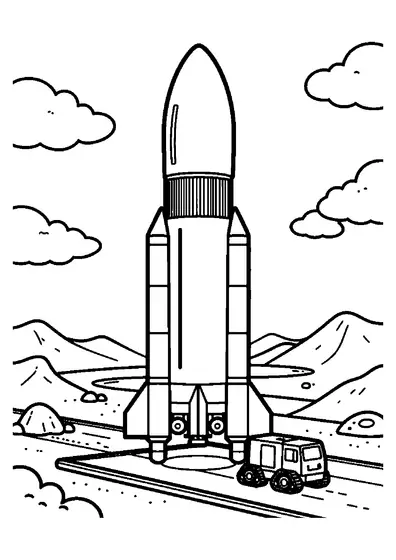
Rocket on Island Launchpad
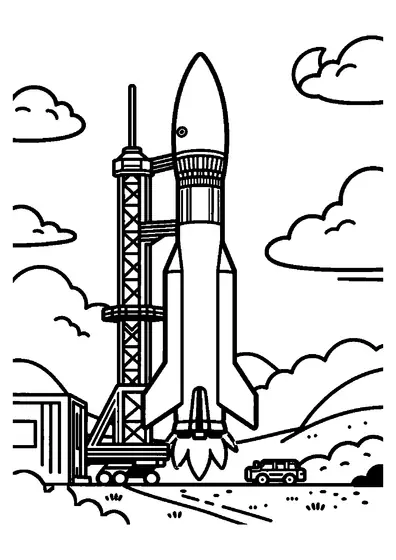
A tall launch vehicle stands ready on a tropical coastline surrounded by palm trees, service structures, and ocean waves.

A4 format (portrait), black outlines on a white background · for home and classroom use
All coloring pages: Space and Rocket Coloring Pages
Similar coloring pages: Space and Rocket Coloring Pages

What else can you print? Free, no account needed
Custom Name Coloring Pages
Enter your child's name to generate a custom coloring page featuring large outline letters to color and decorate.
Open generator →Connect the Dots Generator
Eight connect-the-dots pictures across three difficulty levels. Features faint outline guides for younger children and dots only for older kids.
Open generator →Printables
Worksheets, tracing lines, mazes and dot-to-dots in A4.
Browse printables →
Launch Facility on a Tropical Coast
A tall rocket sits upright on a coastal launch pad, awaiting its mission parameters. Next to the main hull stands a tall service tower used for pre-launch checks and fueling. Surrounding the facility are tropical palm trees, ocean waves rolling onto the shore, and soft clouds floating in the sky overhead.
Why Launch Sites Are Built Near Oceans and the Equator
Spaceports are frequently constructed on coastal land near tropical regions to take advantage of the Earth's natural rotation. Rocket launches heading eastward receive a velocity boost from the spinning planet, which is strongest near the equator. Placing launch pads beside the ocean ensures that spent rocket stages fall safely into open waters far away from populated areas.
Natural Colors of Coastal Launch Sites
- Space vehicle exterior: White ceramic tiles, orange fuel tank insulation, and red trim
- Service tower: Weathered steel gray or bright yellow safety paint
- Palm trees: Emerald green fronds with textured brown trunks
- Ocean water: Turquoise blue near the shore shifting to deep indigo farther out
- Coastline sand: Warm beige or golden yellow ground