
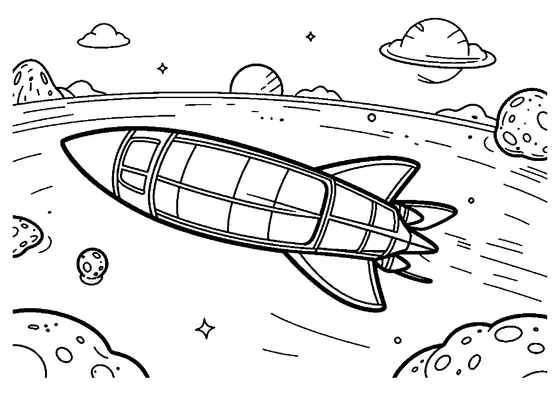
Rocket Flying Over Moon Craters
A spacecraft travels sideways across a quiet lunar horizon filled with ancient impact craters.

A4 format (landscape), black outlines on a white background · for home and classroom use
All coloring pages: Space and Rocket Coloring Pages
Similar coloring pages: Space and Rocket Coloring Pages



What else can you print? Free, no account needed
Custom Name Coloring Pages
Enter your child's name to generate a custom coloring page featuring large outline letters to color and decorate.
Open generator →Connect the Dots Generator
Eight connect-the-dots pictures across three difficulty levels. Features faint outline guides for younger children and dots only for older kids.
Open generator →Printables
Worksheets, tracing lines, mazes and dot-to-dots in A4.
Browse printables →
A Spacecraft Passing Over the Lunar Surface
A side view of a rocket vehicle moves across a plain lunar landscape. Deep bowl-shaped craters and scattered moon rocks cover the rugged ground below the passing craft.
Features of the Moon and Its Terrain
The surface of the Moon is covered in fine dust called regolith alongside millions of impact craters formed by meteoroid collisions over billions of years. Because the Moon lacks an atmosphere, there is no wind or weather to erode these craters, preserving their sharp edges indefinitely.
Natural Colors of the Lunar Environment
- Moon ground: charcoal gray, silver dust, and dark basaltic rock
- Moon craters: shadow black in deep crevices and light ash gray along edges
- Moon rocks: weathered gray, dull white, or dark brown minerality
- Space background: pitch black dotted with distant white stars