
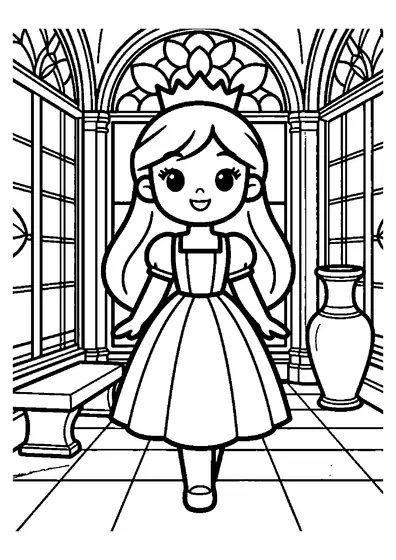
Princess at a Dance Rehearsal
A spacious palace hall with tall stone arches provides an elegant setting for practicing graceful dance steps alongside musical instruments.

A4 format (portrait), black outlines on a white background · for home and classroom use
All coloring pages: Castle and Palace Coloring Pages
Similar coloring pages: Castle and Palace Coloring Pages




What else can you print? Free, no account needed
Custom Name Coloring Pages
Enter your child's name to generate a custom coloring page featuring large outline letters to color and decorate.
Open generator →Connect the Dots Generator
Eight connect-the-dots pictures across three difficulty levels. Features faint outline guides for younger children and dots only for older kids.
Open generator →Printables
Worksheets, tracing lines, mazes and dot-to-dots in A4.
Browse printables →
Dance Practice in the Grand Palace Hall
Courts across Europe emphasized formal dance training as an essential skill for royal etiquette and ceremonial celebrations. In this tall hall lined with classic archways, a princess rehearses dance movement near a wooden bench and a large cello. High ceilings and wide open stone floors provided ample space for practicing music and movement together.
String Instruments in Court Orchestras
The cello developed in sixteenth-century Italy as a deep-toned stringed instrument that provided fundamental bass rhythms for courtly compositions. Musician instrument makers crafted cellos from carved maple and spruce wood, varnishing them to enhance acoustic resonance in large stone halls. Court musicians accompanied dance rehearsals, providing live music for practice sessions before grand balls.
Color Ideas for the Rehearsal Hall
- Cello body: warm amber varnish, golden brown, or dark reddish mahogany
- Hall stone archways: pale limestone, cream sandstone, or soft beige
- Rehearsal bench: polished dark wood with velvet or brocade seating
- Palace hall floor: polished light oak parquet or checkerboard marble tiles
- Cello strings and bridge: silver wire and natural unpainted maple wood