
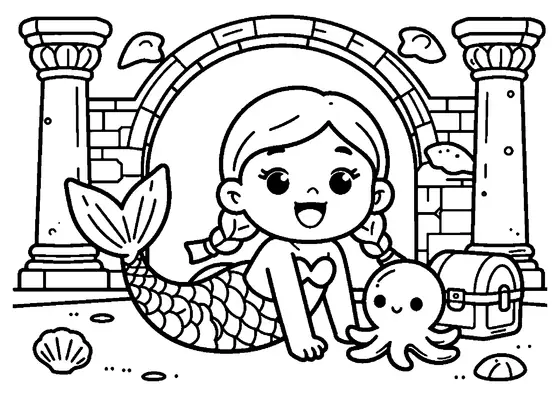
Mermaid Swimming Past Underwater Stone Pillars
An ocean creature glides gracefully past a row of sunken stone pillars resting on the sandy seabed.

A4 format (landscape), black outlines on a white background · for home and classroom use
All coloring pages: Mermaid Coloring Pages
Similar coloring pages: Mermaid Coloring Pages


What else can you print? Free, no account needed
Custom Name Coloring Pages
Enter your child's name to generate a custom coloring page featuring large outline letters to color and decorate.
Open generator →Connect the Dots Generator
Eight connect-the-dots pictures across three difficulty levels. Features faint outline guides for younger children and dots only for older kids.
Open generator →Printables
Worksheets, tracing lines, mazes and dot-to-dots in A4.
Browse printables →
Sunken Colonnade on the Sandy Seabed
Submerged architectural ruins evoke lost coastal settlements gradually reclaimed by rising ocean waters. Rows of heavy stone pillars standing on soft ocean floor sand create sheltered corridors for marine life navigating shallow coastal waters.
Ancient Columns and Seabed Sedimentation
Carved stone columns were designed in antiquity to support massive building roofs and porticos. When ancient coastal structures collapse or sink due to seismic activity, their dense stone elements sink deep into fine ocean sand, preserving their structural shapes against strong currents.
Natural Colors of Sunken Columns and Sea Floor
- Sunken stone pillars: warm sandstone beige, light gray, or mossy olive
- Ocean floor sand: pale cream, golden tan, or light beige
- Seafloor algae on stone bases: dark forest green or reddish brown
- Mermaid tail scales: shimmering aquamarine, royal blue, or lavender