
Traditional Wicker Basket Workshop
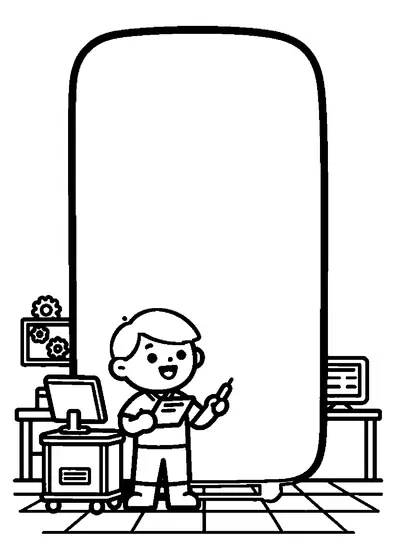
A basket weaver stands beside a large cone-shaped basket formed from flexible willow rods.

A4 format (portrait), black outlines on a white background · for home and classroom use
All coloring pages: Jobs and Professions Coloring Pages
Similar coloring pages: Jobs and Professions Coloring Pages


What else can you print? Free, no account needed
Custom Name Coloring Pages
Enter your child's name to generate a custom coloring page featuring large outline letters to color and decorate.
Open generator →Connect the Dots Generator
Eight connect-the-dots pictures across three difficulty levels. Features faint outline guides for younger children and dots only for older kids.
Open generator →Printables
Worksheets, tracing lines, mazes and dot-to-dots in A4.
Browse printables →
Willow Basket Weaving in a Rural Workshop
The scene presents a short-haired craftsperson and a tall wicker basket with a tapered form. Basket weaving builds a sturdy object by crossing flexible rods over and under one another. Upright pieces establish the structure, while other strands travel around them to create the walls and hold the shape together.
Facts About Willow and Wickerwork
Willow grows long, slender shoots that can be harvested for weaving. The rods are often soaked before use because moisture makes them more flexible and less likely to split while they are bent. The word wicker describes the weaving method or the finished woven work rather than one particular plant.
Real-Life Colors of a Willow Basket
- Fresh willow rods: green, yellow-green, or reddish brown, depending on the variety
- Dried peeled willow: pale cream, straw, or light tan
- Dried unpeeled willow: golden brown, chestnut, or dark brown
- Basket base and rim: natural willow shades, often slightly darker where rods overlap
- Basket weaver's hair: naturally black, brown, blond, red, gray, or white