
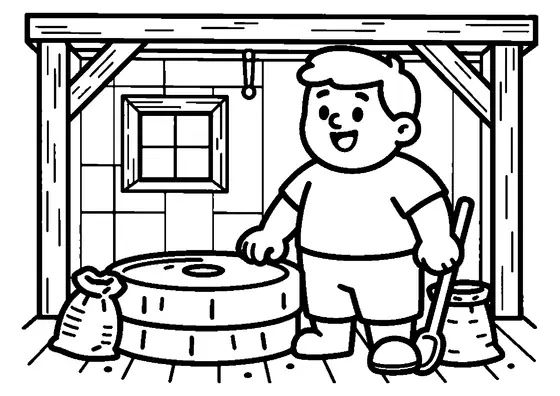
Ceramic Finisher at a Workshop Table
A ceramic artisan smooths a large vase at a worktable inside a pottery workshop.

A4 format (portrait), black outlines on a white background · for home and classroom use
All coloring pages: Jobs and Professions Coloring Pages
Similar coloring pages: Jobs and Professions Coloring Pages


What else can you print? Free, no account needed
Custom Name Coloring Pages
Enter your child's name to generate a custom coloring page featuring large outline letters to color and decorate.
Open generator →Connect the Dots Generator
Eight connect-the-dots pictures across three difficulty levels. Features faint outline guides for younger children and dots only for older kids.
Open generator →Printables
Worksheets, tracing lines, mazes and dot-to-dots in A4.
Browse printables →
Finishing a Ceramic Vase in the Workshop
The artisan is working carefully on the surface and details of a large vessel. Finishing is an important stage because rough areas, uneven rims, or unwanted marks may need attention before the piece is completely dry. The workshop setting is where ceramic objects can be shaped, refined, dried, decorated, and prepared for firing.
Facts About Ceramic Finishing
Freshly shaped clay contains water and gradually becomes firmer as it dries. Potters often refine a vessel when the clay is leather-hard: stiff enough to hold its form but still soft enough to trim or smooth. If a thick piece dries too quickly or unevenly, different parts can shrink at different rates and develop cracks.
Real-Life Colors of Ceramic Materials
- Earthenware clay: commonly reddish brown, tan, or cream
- Stoneware clay: often gray, buff, brown, or off-white before firing
- Porcelain clay: usually pale gray or white before firing
- Fired unglazed vase: cream, tan, red-brown, gray, or white depending on the clay
- Ceramic glaze: available in colors such as blue, green, white, brown, red, or black