
Miller Working at a Stone Mill
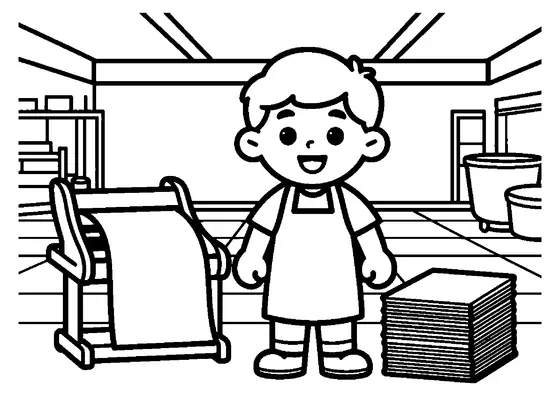
A miller stands beside a traditional stone mill used to turn grain into flour.

A4 format (landscape), black outlines on a white background · for home and classroom use
All coloring pages: Jobs and Professions Coloring Pages
Similar coloring pages: Jobs and Professions Coloring Pages




What else can you print? Free, no account needed
Custom Name Coloring Pages
Enter your child's name to generate a custom coloring page featuring large outline letters to color and decorate.
Open generator →Connect the Dots Generator
Eight connect-the-dots pictures across three difficulty levels. Features faint outline guides for younger children and dots only for older kids.
Open generator →Printables
Worksheets, tracing lines, mazes and dot-to-dots in A4.
Browse printables →
Inside the Miller's Stone Mill
The scene presents a short-haired miller next to a heavy rotating millstone in a flour mill. The stone mill represents a traditional method of grinding grain, while the miller reflects the skilled worker responsible for operating the equipment and watching the flour-making process. Together, these elements introduce an old trade built around food production.
Interesting Facts About Stone Milling
Millstones usually work in pairs: one stone remains still while another rotates above it. Grain passes between their carefully shaped surfaces and is crushed into meal or flour. Millers must control the flow of grain and the distance between the stones because these factors affect the texture of the finished product.
Real-World Colors Found in a Stone Mill
- Millstone: natural gray, charcoal, or brownish gray
- Ground grain: pale tan, cream, or golden beige
- Flour: usually white, off-white, or light brown, depending on the grain
- Miller's work clothes: traditionally white, beige, brown, or muted blue
- Miller's hair: natural shades such as black, brown, blond, red, or gray