
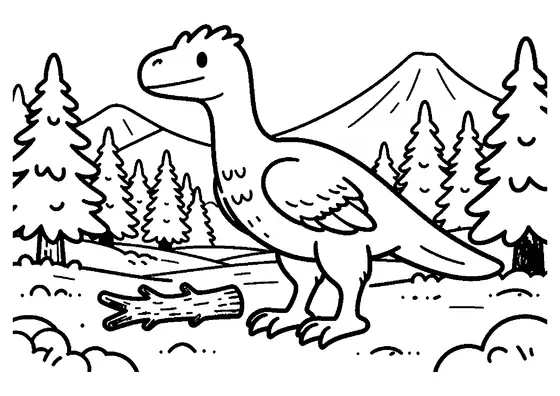
Utahraptor in an Ancient Conifer Forest
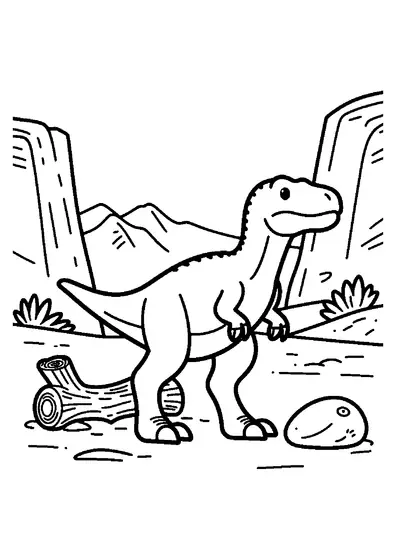
A feathered Utahraptor travels through an ancient conifer forest beside a fallen tree trunk.

A4 format (landscape), black outlines on a white background · for home and classroom use
All coloring pages: Dinosaur Coloring Pages
Similar coloring pages: Dinosaur Coloring Pages

What else can you print? Free, no account needed
Custom Name Coloring Pages
Enter your child's name to generate a custom coloring page featuring large outline letters to color and decorate.
Open generator →Connect the Dots Generator
Eight connect-the-dots pictures across three difficulty levels. Features faint outline guides for younger children and dots only for older kids.
Open generator →Printables
Worksheets, tracing lines, mazes and dot-to-dots in A4.
Browse printables →
Utahraptor in an Ancient Conifer Forest
This forest scene follows Utahraptor as it makes its way past a fallen trunk among conifer trees. The predator had strong hind legs, grasping hands, a long balancing tail, and an enlarged curved claw on each foot. Evidence from related dinosaurs supports depicting its body with feathers.
Life Around Fallen Conifer Trunks
A fallen tree can slowly break down and return nutrients to forest soil, while its position may also influence how water and loose material move across the ground. Conifers reproduce with cones rather than flowers and usually have needle-shaped or scale-shaped leaves. Utahraptor was much larger and more heavily built than several better-known members of the raptor family.
Colors Inspired by Living Animals and Forests
- Utahraptor feathers: its true colors remain unknown; brown, rust, black, cream, or muted gray are plausible natural shades
- Face and lower legs: subdued gray, tan, or brown where skin or scales may have been exposed
- Enlarged foot claws: dark brown, charcoal, or horn-colored
- Conifer needles: deep green, blue-green, or yellow-green depending on the species and season
- Fallen tree trunk: bark brown, reddish brown, gray, or dark umber