
Brachiosaurus in a Dense Pine Forest
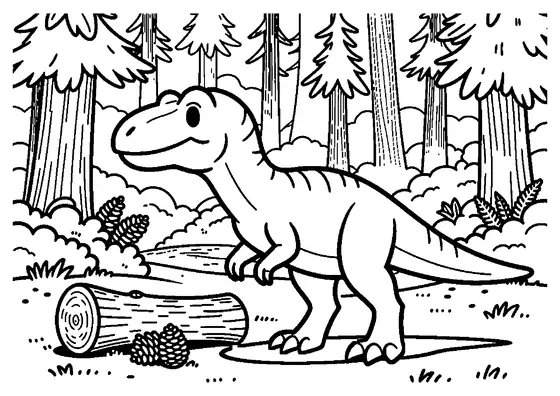
A towering Brachiosaurus lifts its long neck among pine trees and bare trunks in a forest crossed by grass and fallen wood.

A4 format (portrait), black outlines on a white background · for home and classroom use
All coloring pages: Dinosaur Coloring Pages
Similar coloring pages: Dinosaur Coloring Pages




What else can you print? Free, no account needed
Custom Name Coloring Pages
Enter your child's name to generate a custom coloring page featuring large outline letters to color and decorate.
Open generator →Connect the Dots Generator
Eight connect-the-dots pictures across three difficulty levels. Features faint outline guides for younger children and dots only for older kids.
Open generator →Printables
Worksheets, tracing lines, mazes and dot-to-dots in A4.
Browse printables →
Brachiosaurus in the pine forest
The enormous dinosaur stands at the center of the woodland, with four thick legs supporting its rounded body. Its neck reaches toward the upper branches, while its tail extends behind it. Several pine trees and bare trunks rise in the background, and a rock and broken branch rest on the grassy ground near its feet.
Forest life around a giant plant-eater
A long neck allowed Brachiosaurus to browse at heights that many other herbivores could not easily reach. Pine trees belong to a group of plants called conifers, which reproduce with cones rather than flowers. Forest floors also collect fallen branches and dead wood, which gradually break down and return nutrients to the soil.
Natural colors of the forest scene
- Brachiosaurus skin: the precise color is unknown, but olive, brown, sandy tan, or muted gray are reasonable possibilities
- Eyes: dark brown or black, with a small reflective highlight
- Pine needles: usually medium to deep green, though older needles may turn yellow or brown
- Tree trunks and broken branch: gray-brown, reddish brown, or weathered tan
- Grass and rock: fresh to dull green grass beside gray, brown, or rusty stone