
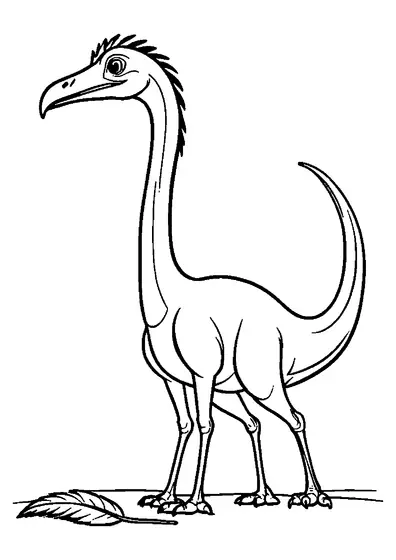
Gallimimus Standing on Grass
A slender Gallimimus stands in profile on grassy ground, displaying its long neck, small head, powerful hind legs, and extended tail.

A4 format (landscape), black outlines on a white background · for home and classroom use
All coloring pages: Predatory Dinosaur Coloring Pages
Similar coloring pages: Predatory Dinosaur Coloring Pages


What else can you print? Free, no account needed
Custom Name Coloring Pages
Enter your child's name to generate a custom coloring page featuring large outline letters to color and decorate.
Open generator →Connect the Dots Generator
Eight connect-the-dots pictures across three difficulty levels. Features faint outline guides for younger children and dots only for older kids.
Open generator →Printables
Worksheets, tracing lines, mazes and dot-to-dots in A4.
Browse printables →
Gallimimus Standing on Grass
The dinosaur is shown upright on two strong hind legs, with small forelimbs held in front of its body. Its narrow neck rises toward a compact head, while the long tail stretches behind it for balance. A simple ground line and several tufts of grass establish the setting without adding other animals or objects.
Life on the Move
Gallimimus belonged to a group of lightly built dinosaurs with body shapes somewhat like those of modern ostriches. Its long legs suggest that it could move quickly across open terrain, while its stiff tail helped stabilize the body. Scientists continue to study its beak and fossil remains to understand exactly what it ate.
Possible Colors of Gallimimus
- Body: the exact color is unknown, but earthy tan or muted brown would suit an animal living on open ground
- Neck and underside: pale beige or sandy cream
- Back: darker brown or gray-brown for natural-looking contrast
- Eyes: dark brown or black
- Grass: fresh green, dry yellow-green, or straw brown