
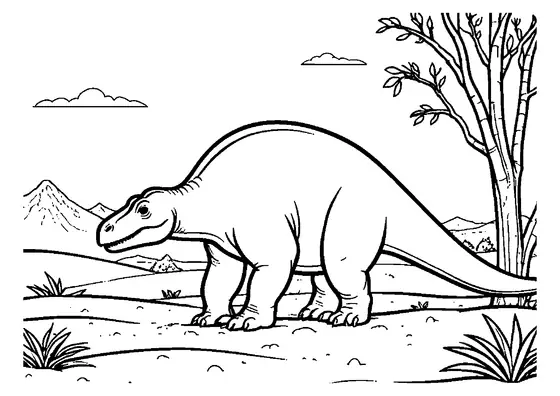
Tenontosaurus Looking at a Hanging Vine
A Tenontosaurus rises on its hind legs to inspect leafy vines hanging among branches above low plants.

A4 format (portrait), black outlines on a white background · for home and classroom use
All coloring pages: Herbivorous Dinosaur Coloring Pages
Similar coloring pages: Herbivorous Dinosaur Coloring Pages



What else can you print? Free, no account needed
Custom Name Coloring Pages
Enter your child's name to generate a custom coloring page featuring large outline letters to color and decorate.
Open generator →Connect the Dots Generator
Eight connect-the-dots pictures across three difficulty levels. Features faint outline guides for younger children and dots only for older kids.
Open generator →Printables
Worksheets, tracing lines, mazes and dot-to-dots in A4.
Browse printables →
Tenontosaurus beneath hanging vines
The dinosaur stands upright and looks toward a leafy vine overhead. Branches and leaves hang from both sides and across the upper part of the scene, while small clumps of plants grow near the ground. Its raised posture brings its head closer to the vegetation.
Curious facts about Tenontosaurus and feeding
Tenontosaurus was a plant-eating dinosaur with a long, strong tail and a beak suited to cropping vegetation. It usually moved on four limbs but could likely rise onto its hind legs, which may have helped it reach plants growing above ground level. Teeth farther back in its mouth processed the plant material after the beak gathered it.
Possible natural colors of this prehistoric scene
- Tenontosaurus body: its exact colors are unknown, but subdued browns, greens, or grayish tones are reasonable possibilities for a large land animal
- Beak: a keratin covering may have appeared tan, brown, gray, or nearly black, much like the beaks of living animals
- Claws: likely pale horn, brown, charcoal, or black
- Vine leaves and branches: living leaves are commonly green, while woody stems range from tan to deep brown
- Ground plants: greens may vary from yellow-green on fresh growth to darker green on mature leaves