
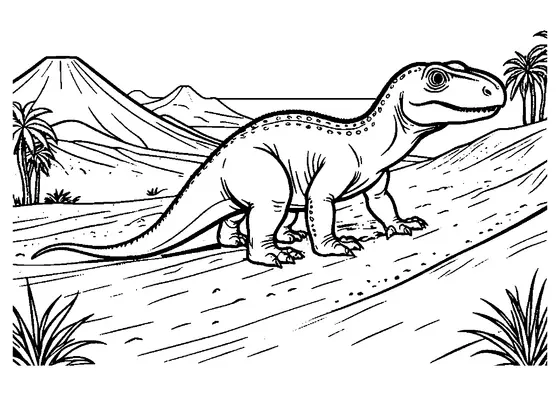
Edmontosaurus Standing by a Meadow Tree
A large Edmontosaurus stands in a prehistoric meadow beside a leafy tree, with hills and clouds beyond.

A4 format (landscape), black outlines on a white background · for home and classroom use
All coloring pages: Herbivorous Dinosaur Coloring Pages
Similar coloring pages: Herbivorous Dinosaur Coloring Pages




What else can you print? Free, no account needed
Custom Name Coloring Pages
Enter your child's name to generate a custom coloring page featuring large outline letters to color and decorate.
Open generator →Connect the Dots Generator
Eight connect-the-dots pictures across three difficulty levels. Features faint outline guides for younger children and dots only for older kids.
Open generator →Printables
Worksheets, tracing lines, mazes and dot-to-dots in A4.
Browse printables →
Edmontosaurus in the Meadow
The broad-bodied herbivore appears beside a tree in an open meadow. Gentle hills stretch across the background, and two clouds hang in the sky. The setting places this duck-billed dinosaur in a calm landscape with nearby vegetation.
Meadow Life and Edmontosaurus
Edmontosaurus had a wide, flattened beak suited to gathering plant material, but it also possessed tightly packed teeth for grinding food. Scientists have found evidence that it could move on either two or four legs, depending on what it was doing. Open ground would have allowed a large animal to travel between feeding areas while keeping a clear view of its surroundings.
Realistic Colors for Edmontosaurus and the Meadow
- Edmontosaurus skin: its true color is unknown; natural browns, olive greens, and dusty tans are plausible
- Beak: muted brown, dark gray, or a horn-like beige
- Meadow vegetation: fresh green, yellow-green, or straw-colored in a dry season
- Tree trunk: brown or gray-brown, sometimes with reddish areas
- Hills and clouds: hills may be green or tan, while clouds are usually white to light gray