
Ouranosaurus Follows a Wavy Trail
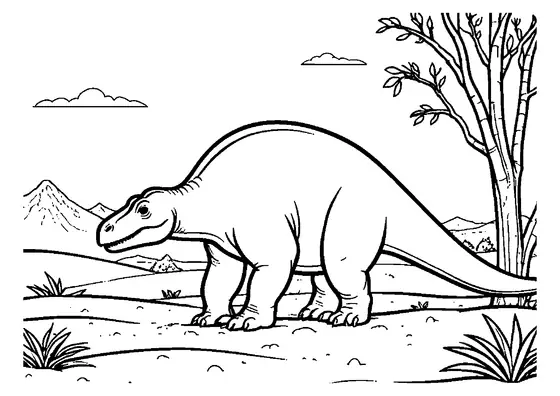
An Ouranosaurus walks across sandy ground beside a winding trail, with low hills in the distance.

A4 format (landscape), black outlines on a white background · for home and classroom use
All coloring pages: Herbivorous Dinosaur Coloring Pages
Similar coloring pages: Herbivorous Dinosaur Coloring Pages


What else can you print? Free, no account needed
Custom Name Coloring Pages
Enter your child's name to generate a custom coloring page featuring large outline letters to color and decorate.
Open generator →Connect the Dots Generator
Eight connect-the-dots pictures across three difficulty levels. Features faint outline guides for younger children and dots only for older kids.
Open generator →Printables
Worksheets, tracing lines, mazes and dot-to-dots in A4.
Browse printables →
Ouranosaurus Following the Wavy Trail
Seen from the side, the dinosaur travels on four legs over a sandy landscape. Wavy marks cross the ground near its feet, while gentle hills form the distant background. The tall ridge along its back gives the animal a distinctive profile.
Reading Trails in Sand
Tracks and winding marks last longest when sand or mud is damp enough to hold their shape and is then covered by another layer of sediment. Fossil trackways can reveal an animal's direction of travel even when no bones are found nearby. The high spines on the back of Ouranosaurus supported a raised structure, although scientists still debate exactly how that structure looked and functioned.
Realistic Colors for Ouranosaurus and Sandy Ground
- Ouranosaurus skin: its original color is unknown; sandy brown, olive, rust, or muted gray are plausible
- Tall back structure: its color is unknown and may be shown in a darker or contrasting natural shade
- Beak: beige, brown, or dark gray
- Sandy ground: pale tan, warm ocher, reddish brown, or light gray
- Distant hills: dusty green, brown, or sun-dried gold