
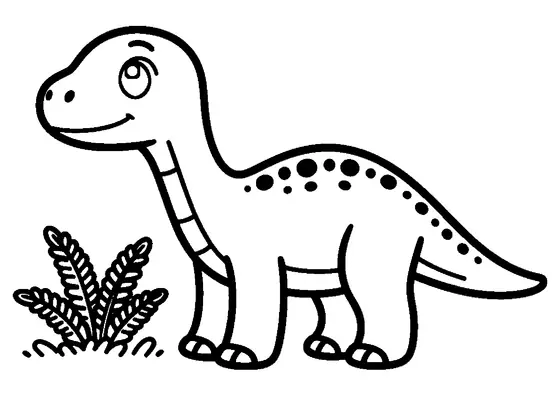
Psittacosaurus Nibbling a Plant
A small Psittacosaurus bends its parrot-like beak toward a broad leaf while resting its short front arms.

A4 format (landscape), black outlines on a white background · for home and classroom use
All coloring pages: Herbivorous Dinosaur Coloring Pages
Similar coloring pages: Herbivorous Dinosaur Coloring Pages




What else can you print? Free, no account needed
Custom Name Coloring Pages
Enter your child's name to generate a custom coloring page featuring large outline letters to color and decorate.
Open generator →Connect the Dots Generator
Eight connect-the-dots pictures across three difficulty levels. Features faint outline guides for younger children and dots only for older kids.
Open generator →Printables
Worksheets, tracing lines, mazes and dot-to-dots in A4.
Browse printables →
The Parrot-Beaked Psittacosaurus Feeding on Ground Foliage
Psittacosaurus was a small, early member of the horned dinosaur lineage that lived across Asia in the Early Cretaceous period. Bending down near low vegetation like a broad-leafed plant, this bipedal herbivore relied on its unusual facial features to forage efficiently. Its compact body structure made it agile and distinct among prehistoric plant eaters.
Unique Characteristics of Psittacosaurus
The name Psittacosaurus means parrot lizard, referring to its short, deep beak used for clipping tough stems and seeds. Fossil discoveries with exceptional preservation reveal that Psittacosaurus had long bristles running along the top of its tail. Unlike later giant ceratopsians, Psittacosaurus walked primarily on its long hind legs, keeping its short front arms free for grabbing branches or handling plant parts.
Real Natural Colors of Psittacosaurus
- Psittacosaurus upper body: reddish brown, tan, or dark chestnut shades for forest camouflage
- Underbelly and chest: pale cream, light beige, or soft tan
- Curved beak: dark horn gray or blackish brown
- Broad leaf plant: rich emerald green, bright jade, or yellowish green