
Pterosaur Flying Straight Ahead
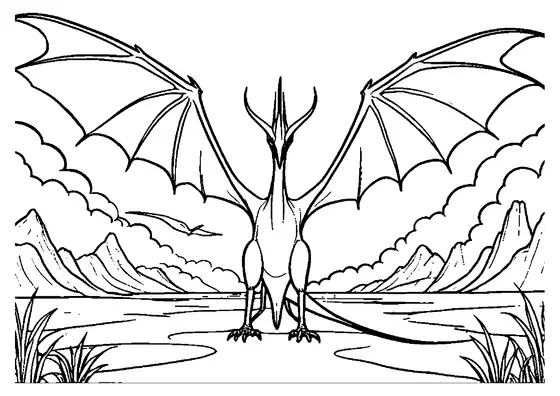
A crested pterosaur flies directly forward with both wings extended to either side.

A4 format (landscape), black outlines on a white background · for home and classroom use
All coloring pages: Flying and Sea Reptile Coloring Pages
Similar coloring pages: Flying and Sea Reptile Coloring Pages




What else can you print? Free, no account needed
Custom Name Coloring Pages
Enter your child's name to generate a custom coloring page featuring large outline letters to color and decorate.
Open generator →Connect the Dots Generator
Eight connect-the-dots pictures across three difficulty levels. Features faint outline guides for younger children and dots only for older kids.
Open generator →Printables
Worksheets, tracing lines, mazes and dot-to-dots in A4.
Browse printables →
A Pterosaur Flying Straight Ahead
The flying reptile faces forward as its body moves through the air, creating a balanced view of its head, torso, and outstretched wings. A large crest rises from its head and forms the most distinctive feature of the animal. No landscape or other objects surround it, so attention stays on its flight posture and body shape.
Interesting Facts About Pterosaur Flight
Pterosaurs were the first vertebrates known to achieve powered flight. Their wing membranes were supported mainly by an extremely lengthened fourth finger, unlike the feathered wings of birds. Many species could also move on the ground by using all four limbs.
Scientifically Plausible Pterosaur Colors
- Wing membranes: exact colors are unknown; brown, tan, gray, or dark reddish tones are plausible
- Body covering: unknown; muted brown, gray, cream, or rust can represent natural coloration
- Head crest: unknown and possibly brighter if it was used for visual display
- Beak: plausible shades include dark gray, brown, tan, or near black
- Eyes: dark brown or black are reasonable natural choices