
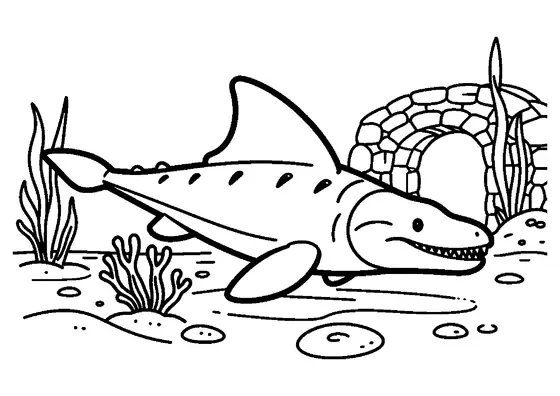
Mosasaur Emerging From a Sunken Sea Cave
An ocean predator known as a mosasaur moves out from a dark underwater cavern toward a sandy sea floor with coral formations.

A4 format (landscape), black outlines on a white background · for home and classroom use
All coloring pages: Flying and Sea Reptile Coloring Pages
Similar coloring pages: Flying and Sea Reptile Coloring Pages




What else can you print? Free, no account needed
Custom Name Coloring Pages
Enter your child's name to generate a custom coloring page featuring large outline letters to color and decorate.
Open generator →Connect the Dots Generator
Eight connect-the-dots pictures across three difficulty levels. Features faint outline guides for younger children and dots only for older kids.
Open generator →Printables
Worksheets, tracing lines, mazes and dot-to-dots in A4.
Browse printables →
A Mosasaur Navigating Underwater Caverns
Mosasaurs dominated ancient oceans as formidable marine predators. Entering and exiting natural stone caves along coastal sea basins allowed these streamlined aquatic reptiles to inspect underwater shelters, navigate submerged rock structures, and locate marine prey near coral reefs.
Marine Adaptation of Prehistoric Reptiles
Ancestors of mosasaurs were land-dwelling lizards that gradually adapted to life in open water. Over millions of years, their limbs transformed into flippers, and their tails developed powerful fins suited for rapid swimming through deep ocean waters.
Real Colors of Mosasaurs and Submerged Coral Banks
- Mosasaur hide: Dark blue, slate gray, or greenish-black on top with a light belly countershading
- Underwater sea cave: Deep gray, dark brown, and shadowed slate rock
- Sandy ocean floor: Pale tan, cream, and beige sediment
- Coral bank formations: Subdued shades of orange, purple, pink, and olive green