
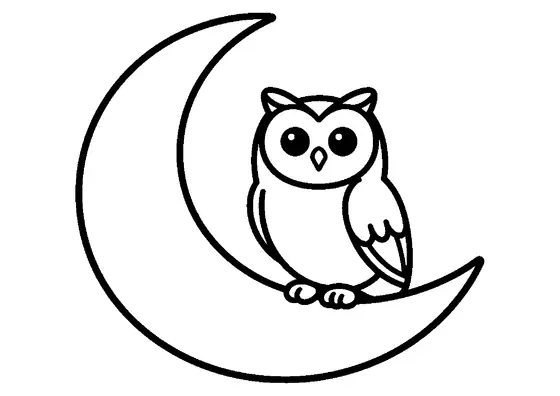
Tawny owl facing forward on a thick branch
A round head and wide eyes define a tawny owl sitting facing forward on a thick tree branch.

A4 format (portrait), black outlines on a white background · for home and classroom use
All coloring pages: Woodland Animal Coloring Pages
Similar coloring pages: Woodland Animal Coloring Pages



What else can you print? Free, no account needed
Custom Name Coloring Pages
Enter your child's name to generate a custom coloring page featuring large outline letters to color and decorate.
Open generator →Connect the Dots Generator
Eight connect-the-dots pictures across three difficulty levels. Features faint outline guides for younger children and dots only for older kids.
Open generator →Printables
Worksheets, tracing lines, mazes and dot-to-dots in A4.
Browse printables →
Tawny Owl Perched on a Branch
A tawny owl sits facing forward on a thick tree branch. The bird has a round head, wide forward-facing eyes, and a soft feathered body. Its calm posture on the wooden limb reflects the resting position of an owl perched high off the ground.
Night Vision and Perching Habits of Owls
Tawny owls rely on exceptionally large eyes and keen hearing to locate small rodents moving through forest undergrowth in total darkness. Their soft wing feathers are specially structured to muffle airflow, allowing them to fly silently from branch to branch. While perching quietly on tree limbs, these birds can rotate their heads up to two hundred and seventy degrees to scan their surroundings.
Real Colors of the Tawny Owl
- Owl body feathers: Mottled reddish-brown, buff, and warm tan with dark streaks
- Round head and facial disc: Soft pale brown or off-white
- Owl eyes: Deep brown or black
- Tree branch bark: Dark brown or gray-brown