
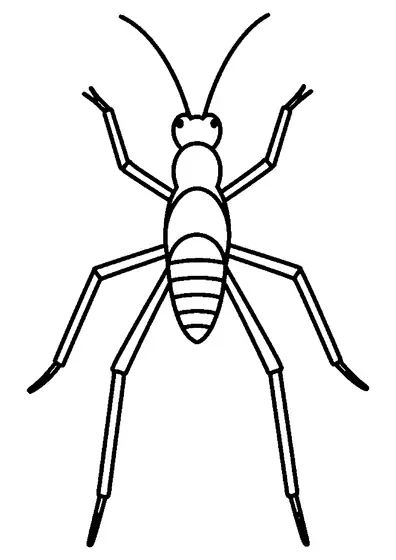
Caddisfly on a Waterside Leaf
A caddisfly rests on a broad leaf growing near the edge of a pond.

A4 format (landscape), black outlines on a white background · for home and classroom use
All coloring pages: Woodland Animal Coloring Pages
Similar coloring pages: Woodland Animal Coloring Pages




What else can you print? Free, no account needed
Custom Name Coloring Pages
Enter your child's name to generate a custom coloring page featuring large outline letters to color and decorate.
Open generator →Connect the Dots Generator
Eight connect-the-dots pictures across three difficulty levels. Features faint outline guides for younger children and dots only for older kids.
Open generator →Printables
Worksheets, tracing lines, mazes and dot-to-dots in A4.
Browse printables →
A Caddisfly Settled on a Pond Leaf
A caddisfly sits atop a leaf, viewed in a posture typical of pond habitats. Its long antennae extend forward, while its wings are folded tightly over its back like a roof.
Interesting Facts About Caddisflies
Before transforming into winged adults, caddisfly larvae live underwater and construct protective cases around their bodies. They bind tiny pebbles, sand grains, bits of wood, or small shell fragments together using waterproof silk produced by their salivary glands. These natural cases shield the soft larvae from hungry fish and swift water currents.
True Colors of a Caddisfly
- Caddisfly wings: muted brown, gray, or mottled tan with tiny hairs
- Caddisfly antennae: dark brown or yellowish-gray with fine segments
- Caddisfly body: dull brownish-black or dark olive
- Waterside leaf: deep green or bright yellowish-green