
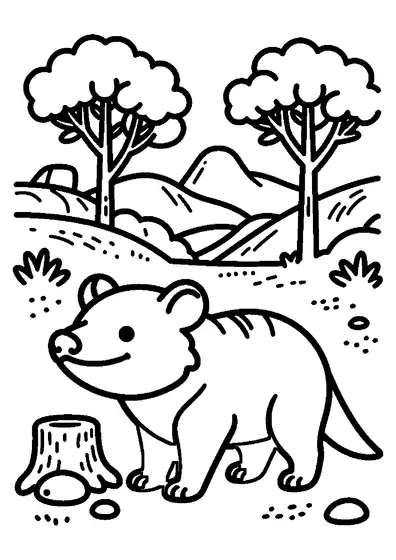
Wombat at the Entrance to a Sandy Burrow
A solitary marsupial stands at the threshold of its underground home set within the dry Australian bush.

A4 format (portrait), black outlines on a white background · for home and classroom use
All coloring pages: Wild Animal Coloring Pages
Similar coloring pages: Wild Animal Coloring Pages



What else can you print? Free, no account needed
Custom Name Coloring Pages
Enter your child's name to generate a custom coloring page featuring large outline letters to color and decorate.
Open generator →Connect the Dots Generator
Eight connect-the-dots pictures across three difficulty levels. Features faint outline guides for younger children and dots only for older kids.
Open generator →Printables
Worksheets, tracing lines, mazes and dot-to-dots in A4.
Browse printables →
Australian Wombat and Its Underground Habitat
This depiction highlights a heavy-set wombat pausing near the entrance of a sandy burrow. The surrounding scene reflects the natural Australian bush landscape where these burrowing animals dig extensive network tunnels.
Burrowing Habits of Native Wildlife
Wombats build massive underground burrows that can reach up to ninety feet in length to escape extreme heat. Their backward-facing pouches prevent sand from covering their young while digging through soil. These powerful diggers use strong claws and sturdy legs to move massive amounts of earth.
Colors of the Wombat and Bush Soil
- Wombat fur: sandy brown, grayish brown, or black
- Wombat nose and paws: dark gray or soft black
- Sandy burrow mound: warm tan, ochre, or pale beige soil
- Bush ground cover: muted olive green, dry straw, and dark earth