
African Buffalo in a Seasonal Wetland
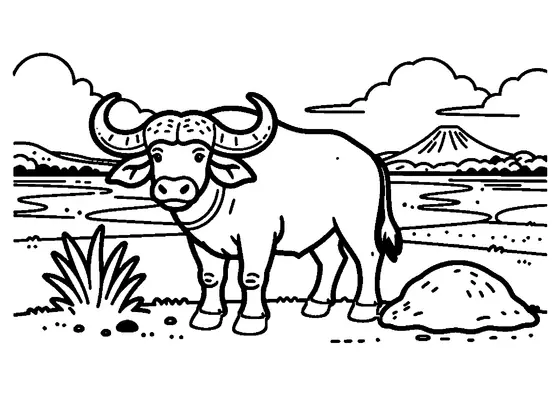
An African buffalo stands in a lush seasonal wetland surrounded by tall reeds, dry ground, and hills.

A4 format (landscape), black outlines on a white background · for home and classroom use
All coloring pages: African Animal Coloring Pages
Similar coloring pages: African Animal Coloring Pages


What else can you print? Free, no account needed
Custom Name Coloring Pages
Enter your child's name to generate a custom coloring page featuring large outline letters to color and decorate.
Open generator →Connect the Dots Generator
Eight connect-the-dots pictures across three difficulty levels. Features faint outline guides for younger children and dots only for older kids.
Open generator →Printables
Worksheets, tracing lines, mazes and dot-to-dots in A4.
Browse printables →
African Buffalo in a Wetland Environment
The African buffalo is a robust herbivore easily recognized by its heavy body and fused curved horns. In this setting, the animal stands amidst wetland vegetation, standing water, patches of soil, and distant rolling hills.
Wildlife Facts About the African Buffalo
Seasonal wetlands provide crucial drinking water and mud wallows for buffalos during hot African afternoons. Coated mud acts as a natural sunscreen and shields the animal's thick skin from biting insects. These grazers form large cooperative herds that help protect individual members from big cats like lions.
Real Colors of the African Buffalo and Wetland
- Horns and head shield: dark gray or black
- Coat and body hide: deep brownish black
- Reeds and wetland plants: olive green and yellow-green
- Wetland water and mud: muddy brown and slate gray
- Distant hills: muted blue-gray and brown