
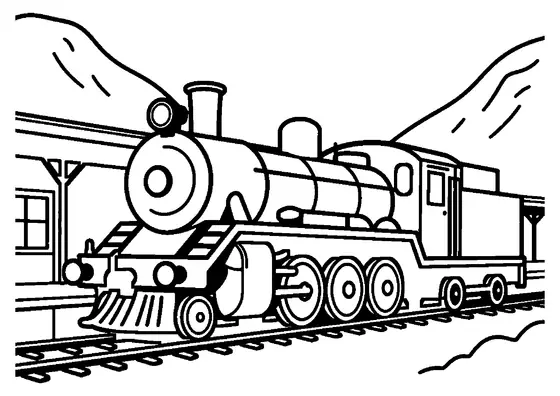
Locomotive at a Country Station
A powerful train engine comes to a stop alongside a quiet rural passenger stop surrounded by steel tracks.

A4 format (landscape), black outlines on a white background · for home and classroom use
All coloring pages: Train Coloring Pages
Similar coloring pages: Train Coloring Pages




What else can you print? Free, no account needed
Custom Name Coloring Pages
Enter your child's name to generate a custom coloring page featuring large outline letters to color and decorate.
Open generator →Connect the Dots Generator
Eight connect-the-dots pictures across three difficulty levels. Features faint outline guides for younger children and dots only for older kids.
Open generator →Printables
Worksheets, tracing lines, mazes and dot-to-dots in A4.
Browse printables →
Passenger Train Engine at a Rural Depot
A large locomotive has come to a rest at a peaceful country stop. Next to the railroad tracks, the wooden platform features a passenger bench with a suitcase sitting nearby. A small station building stands next to the platform alongside an unmarked railway signal post.
How Rural Railway Stations Operate
Country stations provided vital transport links connecting smaller towns to major cities long before highway networks expanded. Station masters managed incoming passenger luggage and operated manual signals to direct track traffic safely. Passengers often waited on open platforms, relying on precise railway pocket watches to catch their scheduled train.
Authentic Colors of Classic Railway Equipment
- Train engine body: dark blue, deep red, or black
- Passenger bench: natural oak brown or painted green
- Luggage suitcase: tan leather or dark brown
- Station building roof: terracotta red or slate gray
- Railway tracks: silver steel with dark wooden ties