
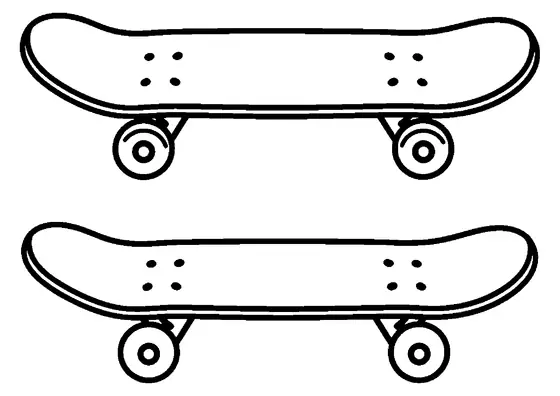
Symmetrical Skateboard from Above
A top-down view shows a symmetrical skateboard deck featuring evenly rounded ends and a wide center section.

A4 format (portrait), black outlines on a white background · for home and classroom use
All coloring pages: Sports Coloring Pages
Similar coloring pages: Sports Coloring Pages


What else can you print? Free, no account needed
Custom Name Coloring Pages
Enter your child's name to generate a custom coloring page featuring large outline letters to color and decorate.
Open generator →Connect the Dots Generator
Eight connect-the-dots pictures across three difficulty levels. Features faint outline guides for younger children and dots only for older kids.
Open generator →Printables
Worksheets, tracing lines, mazes and dot-to-dots in A4.
Browse printables →
Top View of a Symmetrical Deck
This perspective presents a skateboard deck viewed directly from above in a fully symmetrical orientation. Both the front nose and rear tail share identical rounded ends connected by a wide center section. The upper deck offers a view of standard board proportions.
Symmetrical Board Designs
Symmetrical skateboards, often called twin-tip boards, feature identical nose and tail dimensions so riders can skate in either direction without changing stance. This design allows street skaters to land tricks backward and immediately transition into their next move. Most modern trick skateboards use near-symmetrical shapes to maximize balance and trick versatility.
Real Colors of a Symmetrical Skateboard Deck
- Upper deck surface: Black textured grip tape, dark gray, or natural wood veneer
- Deck border rim: Multi-colored plywood layers showing thin bands of red, blue, or yellow
- Exposed hardware bolt tops: Black steel, silver metal, or colored anodized screws