
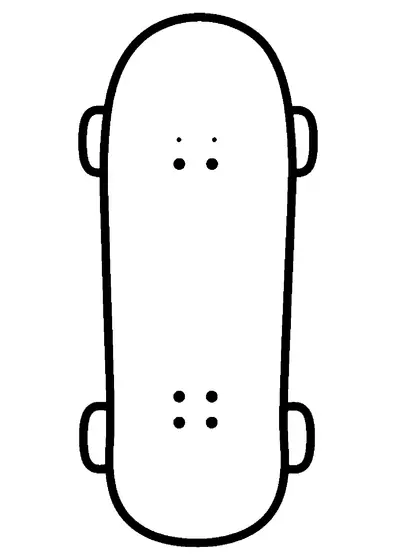
Skateboard Deck with Rounded Ends
Viewed from above, a traditional skateboard deck presents its symmetrical wooden shape with rounded nose and tail ends and mounting holes.

A4 format (portrait), black outlines on a white background · for home and classroom use
All coloring pages: Sports Coloring Pages
Similar coloring pages: Sports Coloring Pages




What else can you print? Free, no account needed
Custom Name Coloring Pages
Enter your child's name to generate a custom coloring page featuring large outline letters to color and decorate.
Open generator →Connect the Dots Generator
Eight connect-the-dots pictures across three difficulty levels. Features faint outline guides for younger children and dots only for older kids.
Open generator →Printables
Worksheets, tracing lines, mazes and dot-to-dots in A4.
Browse printables →
Skateboard Deck Structure
The deck serves as the primary standing platform of a skateboard, supporting the weight of the rider during movement and tricks. Seen from an overhead angle, this deck features rounded ends corresponding to the nose and tail sections. Small mounting holes are positioned near both ends to accommodate the bolt assemblies for axle trucks.
Wood Crafting Facts for Skateboard Decks
Most modern skateboard decks consist of seven thin layers of hard rock maple wood pressed together under high hydraulic pressure using waterproof glue. This multi-ply construction creates a lightweight yet exceptionally resilient board that flexes without snapping easily under heavy loads. The slight upward curve at each end, called the kicktail, enables riders to lift the board off the ground.
Real Colors of a Skateboard Deck
- Top Surface Grip Tape: Dark black, gray, or textured charcoal
- Exposed Wood Edges: Light natural maple or pale cream wood grain
- Mounting Holes: Dark interior openings showing underlying bolt threads
- Deck Finish: Natural wood lacquer or solid background stain