
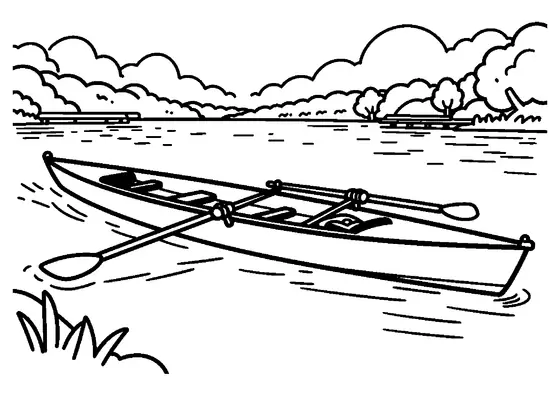
Rowing Boat Side View
A long competitive rowing shell stretches horizontally with its narrow hull, internal athlete seating, and extended oars.

A4 format (landscape), black outlines on a white background · for home and classroom use
All coloring pages: Sports Coloring Pages
Similar coloring pages: Sports Coloring Pages


What else can you print? Free, no account needed
Custom Name Coloring Pages
Enter your child's name to generate a custom coloring page featuring large outline letters to color and decorate.
Open generator →Connect the Dots Generator
Eight connect-the-dots pictures across three difficulty levels. Features faint outline guides for younger children and dots only for older kids.
Open generator →Printables
Worksheets, tracing lines, mazes and dot-to-dots in A4.
Browse printables →
Design of a Water Sports Rowing Shell
A sleek rowing vessel engineered for athletic training displays a streamlined hull built to glide across calm water. The side perspective showcases internal seating positions alongside long oars mounted to rigged supports that propel the narrow boat forward.
Interesting Facts About Competitive Rowing
Rowing shells are among the longest and narrowest watercraft used in modern sports, engineered specifically to minimize hydrodynamic resistance. Rowers sit on sliding seats that move along tracks, allowing them to use the powerful muscles in their legs rather than relying solely on arm strength. In team events, rowers sit facing backward toward the stern, relying on precise timing to pull their oars in complete synchronization.
True Colors of Racing Rowing Boats
- Carbon fiber hull: bright white, glossy yellow, or deep navy blue
- Oar shafts: matte black synthetic composite or dark brown wood
- Oar spoon blades: team colors such as bright red, white, or blue stripes
- Athlete seats: dark gray plastic or black padded composite
- Side outrigger riggers: silver aluminum or black coated metal