
Futsal Player at Pop-Up Goal
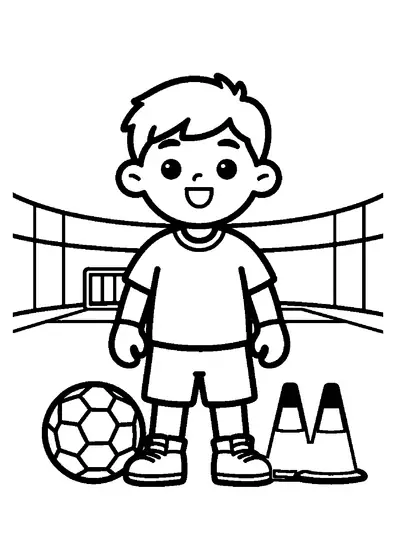
An indoor athlete poses alongside a portable net and ball inside a spacious gymnasium setting.

A4 format (landscape), black outlines on a white background · for home and classroom use
All coloring pages: Sports Coloring Pages
Similar coloring pages: Sports Coloring Pages




What else can you print? Free, no account needed
Custom Name Coloring Pages
Enter your child's name to generate a custom coloring page featuring large outline letters to color and decorate.
Open generator →Connect the Dots Generator
Eight connect-the-dots pictures across three difficulty levels. Features faint outline guides for younger children and dots only for older kids.
Open generator →Printables
Worksheets, tracing lines, mazes and dot-to-dots in A4.
Browse printables →
Indoor Futsal Action in the Gymnasium
A young futsal athlete stands inside a sports hall beside a ball and a portable pop-up goal. Indoor sports halls feature hard court surfaces bounded by walls, providing dedicated training spaces for fast-paced small-sided games.
Insights into Futsal and Indoor Training
Futsal originated in South America during the 1930s as a way to practice soccer skills in restricted indoor spaces. Portable pop-up goals use flexible fiberglass frames that collapse quickly, making them ideal for training drills on polished indoor floors.
Authentic Colors of Indoor Sports Equipment
- Futsal ball: traditionally white or high-visibility yellow with colorful panel accents like navy or red
- Portable goal frame: bright neon orange, yellow, or white flexible fabric around black mesh netting
- Sports hall floor: warm wooden hardwood tan, light brown, or blue synthetic court material
- Indoor court walls: neutral light gray, beige, or white painted masonry with protective padding