
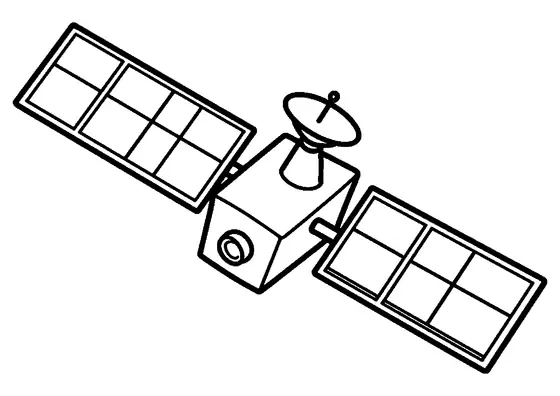
Communications Satellite with Dish
An orbital relay spacecraft equipped with a prominent parabolic antenna transmits communication signals across immense distances.

A4 format (portrait), black outlines on a white background · for home and classroom use
All coloring pages: Planet and Solar System Coloring Pages
Similar coloring pages: Planet and Solar System Coloring Pages




What else can you print? Free, no account needed
Custom Name Coloring Pages
Enter your child's name to generate a custom coloring page featuring large outline letters to color and decorate.
Open generator →Connect the Dots Generator
Eight connect-the-dots pictures across three difficulty levels. Features faint outline guides for younger children and dots only for older kids.
Open generator →Printables
Worksheets, tracing lines, mazes and dot-to-dots in A4.
Browse printables →
Deep Space Communications Satellite
Relay satellites orbiting in space serve as vital communication hubs, connecting remote stations and explorers across vast distances. The expansive dish antenna captures faint signal frequencies, while wide solar panels supply electrical energy to power high-powered transmitters.
Long-Distance Radio Signal Transmission
Communications satellites receive radio signals from ground locations, amplify their power, and bounce them back down to distant receivers across the globe or across interplanetary space. Radio waves travel at the speed of light, but sending messages across interplanetary distances can still take anywhere from several minutes to hours. To protect sensitive communications equipment from radiation and heat, satellites are wrapped in specialized multi-layer insulation foils.
Authentic Colors of Communication Spacecraft
- Parabolic dish antenna: bright white, silver, or light aluminum gray
- Satellite structure: gold insulation foil or reflective silver metal
- Solar panel arrays: dark navy blue or dark blue-green
- Panel mounting struts: dark gray or black composite material