
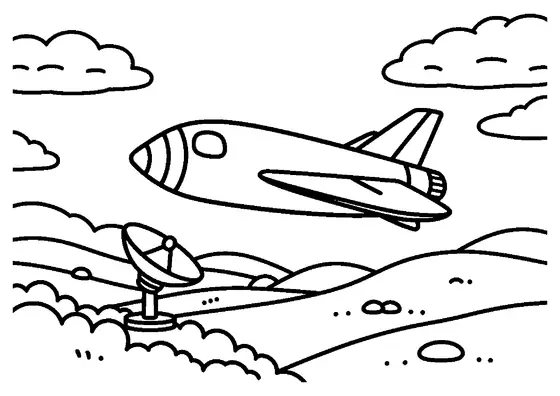
Rocket over Stone Sphere Valley
A winged rocket glides above a wide valley filled with spherical stone boulders, passing over a ground antenna and landing marker.

A4 format (landscape), black outlines on a white background · for home and classroom use
All coloring pages: Space and Rocket Coloring Pages
Similar coloring pages: Space and Rocket Coloring Pages


What else can you print? Free, no account needed
Custom Name Coloring Pages
Enter your child's name to generate a custom coloring page featuring large outline letters to color and decorate.
Open generator →Connect the Dots Generator
Eight connect-the-dots pictures across three difficulty levels. Features faint outline guides for younger children and dots only for older kids.
Open generator →Printables
Worksheets, tracing lines, mazes and dot-to-dots in A4.
Browse printables →
Winged Spacecraft Flying Over a Sphere-Filled Valley
A winged rocket glides gracefully through the sky above a unique canyon valley scattered with massive spherical stone boulders. Down on the valley floor, a tall signal antenna and a clear landing marker pinpoint an established navigational location for aircraft.
Geologic Wonders of Spherical Boulders
Spherical rocks, known to geologists as concretions, form when mineral cement precipitates inside sedimentary layers around a central core. Over time, surrounding softer stone erodes away, leaving remarkably round boulders exposed across valley floors. Winged space vehicles use atmospheric lift from wings to glide efficiently through planetary air layers before touching down.
Authentic Colors of Winged Rockets and Stone Valleys
- Winged rocket hull: matte white, midnight blue, or silver with orange wingtips
- Spherical stone boulders: granite gray, sandy beige, rust orange, or dark charcoal
- Signal antenna: aluminum silver, steel gray, or warning yellow
- Ground landing marker: high-visibility yellow, neon green, or stark white