
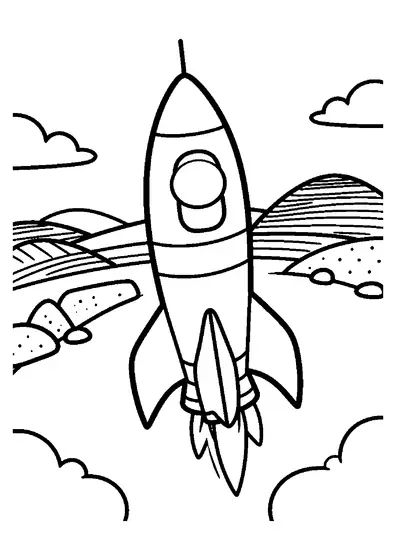
Rocket Over Gentle Craters
A space rocket glides smoothly over a landscape marked by wide, shallow craters under a sky filled with clouds.

A4 format (landscape), black outlines on a white background · for home and classroom use
All coloring pages: Space and Rocket Coloring Pages
Similar coloring pages: Space and Rocket Coloring Pages


What else can you print? Free, no account needed
Custom Name Coloring Pages
Enter your child's name to generate a custom coloring page featuring large outline letters to color and decorate.
Open generator →Connect the Dots Generator
Eight connect-the-dots pictures across three difficulty levels. Features faint outline guides for younger children and dots only for older kids.
Open generator →Printables
Worksheets, tracing lines, mazes and dot-to-dots in A4.
Browse printables →
Space Rocket Gliding Over Shallow Craters
This view shows a rocket traveling over terrain covered in broad, shallow impact craters beneath fluffy atmospheric clouds. Craters form when meteorites strike planetary surfaces, creating circular depressions with low rims. Clouds floating overhead indicate an active atmosphere where weather patterns continuously reshape surface features.
Impact Craters and Cloud Formation in Atmospheres
Shallow craters occur when older impact sites undergo erosion from atmospheric winds or volcanic dust infill over millions of years. Unlike airless bodies where craters stay sharp forever, planets with atmospheres and clouds experience weathering that smooths crater walls. Studying cloud movements above crater basins helps meteorologists understand planetary weather systems.
Real Colors of Rockets, Craters, and Clouds
- Rocket fuselage: stark white ceramic tiles with silver trim
- Rocket thruster nozzles: matte black or dark gunmetal gray
- Shallow crater walls: light dusty gray, beige, or pale tan rock
- Crater interior basin: shadowed charcoal gray or brownish earth
- Atmospheric clouds: pure white with light gray undersides