
Rocket on the Edge of a Shallow Crater
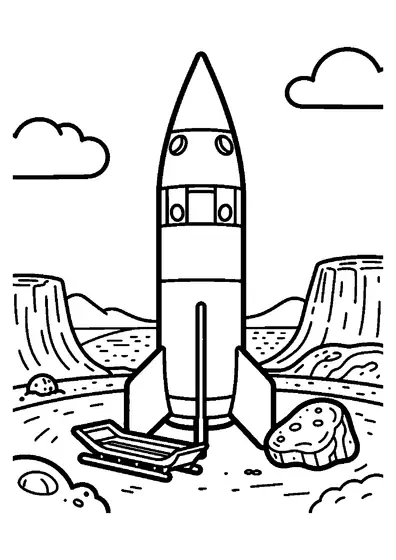
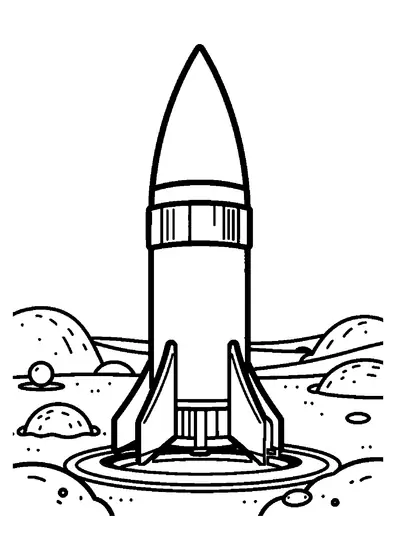
A massive space rocket rests near the rim of a wide, shallow crater surrounded by rocky hills on a lunar surface landscape.

A4 format (landscape), black outlines on a white background · for home and classroom use
All coloring pages: Space and Rocket Coloring Pages
Similar coloring pages: Space and Rocket Coloring Pages
What else can you print? Free, no account needed
Custom Name Coloring Pages
Enter your child's name to generate a custom coloring page featuring large outline letters to color and decorate.
Open generator →Connect the Dots Generator
Eight connect-the-dots pictures across three difficulty levels. Features faint outline guides for younger children and dots only for older kids.
Open generator →Printables
Worksheets, tracing lines, mazes and dot-to-dots in A4.
Browse printables →
Lunar Landing Exploration Near Impact Craters
A large rocket stands positioned on the rocky edge of a broad crater surrounded by rolling hills. Impact craters formed by asteroid or meteorite strikes offer planetary geologists access to deep subsurface rock layers without requiring extensive drilling operations.
Surface Features of Shallow Lunar Craters
Shallow craters are formed when incoming meteorites hit planetary surfaces at high speeds, creating wide depressions with raised outer rims. Over time, smaller impacts and micro-meteorite erosion soften crater edges, turning sharp drop-offs into smooth sloping hills. Landing space vehicles near crater rims allows exploration missions to collect diverse mineral samples from underlying geological strata.
Real Colors of Lunar Craters and Planetary Ships
- Rocket hull: titanium white, silver heat shield foil, or dark charcoal panels
- Crater rim and slope: dusty gray regolith, ash gray, or pale beige rock dust
- Surrounding hills: shadowed slate gray, dark stone brown, or basalt charcoal
- Surface boulders: granite gray, dark brown, or speckled black rock