
Rocket on Fossil Moon
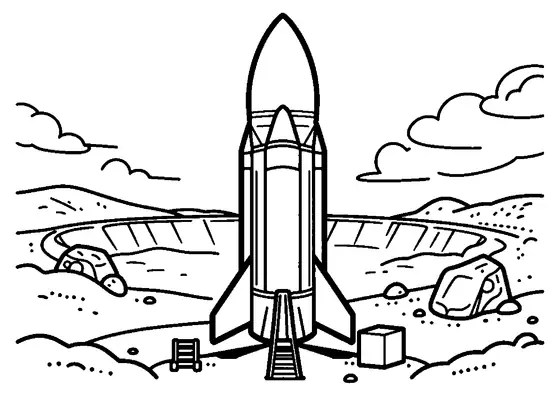
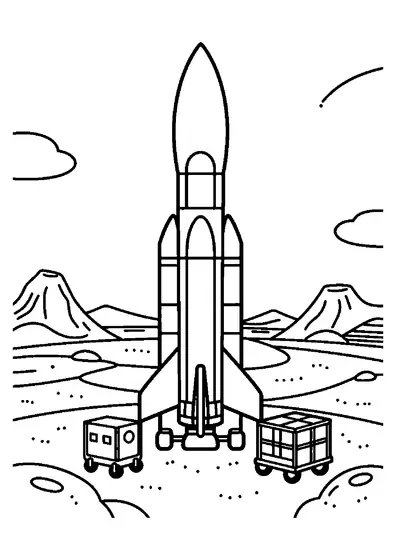
A large research spacecraft rests near a transport cart and an ancient embedded fossil on a barren lunar surface.

A4 format (portrait), black outlines on a white background · for home and classroom use
All coloring pages: Space and Rocket Coloring Pages
Similar coloring pages: Space and Rocket Coloring Pages


What else can you print? Free, no account needed
Custom Name Coloring Pages
Enter your child's name to generate a custom coloring page featuring large outline letters to color and decorate.
Open generator →Connect the Dots Generator
Eight connect-the-dots pictures across three difficulty levels. Features faint outline guides for younger children and dots only for older kids.
Open generator →Printables
Worksheets, tracing lines, mazes and dot-to-dots in A4.
Browse printables →
Lunar Paleontology and Space Research
A research spacecraft sits stationary on rocky lunar terrain beside a heavy transport cart. Nearby, a large fossilized structure remains exposed in the moon rock, indicating ancient history embedded in the soil. The environment combines technical exploration tools with geological discovery across a stark landscape.
Secrets of Fossils and Lunar Geology
Fossils form when water containing dissolved minerals replaces organic matter in bones or shells over millions of years, preserving structural shapes within solid rock. Finding preserved remains on a moon would indicate that liquid water and biological organisms existed long before current dry conditions developed. Scientists use specialized carts to transport delicate rock slabs containing fossils back to lab modules without damaging brittle specimens.
Natural Colors of Lunar Terrain and Fossils
- Rocket body: titanium white or polished nickel with blue accent lines
- Ancient fossil: chalky beige, slate gray, or mineral-stained brown
- Transport cart: heavy-duty orange or industrial gray alloy
- Lunar ground: dark graphite gray, basalt black, or dusty silver gravel
- Moon rocks: charcoal, dark tan, or speckled granite gray