
Old Tree Stump with Honey Mushrooms in a Beech Forest
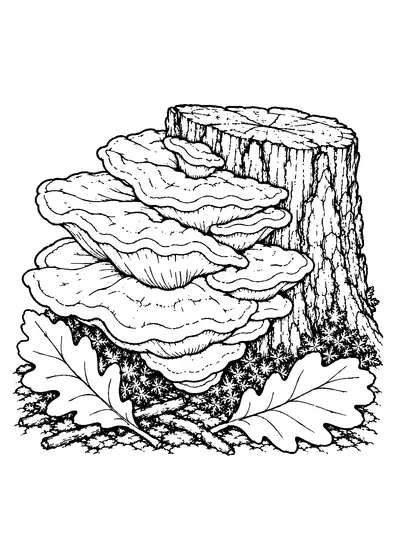
Clusters of honey mushrooms grow over an aging oak tree stump in an autumn beech forest beside a magnifying glass.

A4 format (portrait), black outlines on a white background · for home and classroom use
All coloring pages: Mushroom Coloring Pages
Similar coloring pages: Mushroom Coloring Pages




What else can you print? Free, no account needed
Custom Name Coloring Pages
Enter your child's name to generate a custom coloring page featuring large outline letters to color and decorate.
Open generator →Connect the Dots Generator
Eight connect-the-dots pictures across three difficulty levels. Features faint outline guides for younger children and dots only for older kids.
Open generator →Printables
Worksheets, tracing lines, mazes and dot-to-dots in A4.
Browse printables →
Honey Mushrooms Growing on an Old Tree Stump
Dense clusters of honey mushrooms sprout across the weathered surface of an old oak stump deep in an autumn beech forest. Nearby, a magnifying glass rests on the forest ground, highlighting the delicate fungal gills and caps. Golden beech foliage frames the decaying wood, showing how decaying timber supports new fungal life in the woods.
Natural Wonders of Honey Mushrooms and Decaying Wood
Honey mushrooms get their name from their warm honey-yellow color and grow in tight clusters on decaying wood or living trees. Below the soil, honey mushroom colonies can form massive underground fungal networks called mycelium, covering huge acreage. Old tree stumps decompose slowly over decades, returning vital organic nutrients back into the woodland soil.
Real Colors of Honey Mushrooms and Beech Trees
- Honey mushroom caps: Golden yellow, warm honey, or brownish-yellow
- Honey mushroom stems: Light yellowish-tan, shading to darker brown near the base
- Old oak tree stump: Weathered dark brown, mossy green, and silver-gray bark
- Beech forest leaves: Vivid amber, copper-brown, bright yellow, and warm orange
- Magnifying glass frame: Metallic silver, dark gray, or brassy brown