
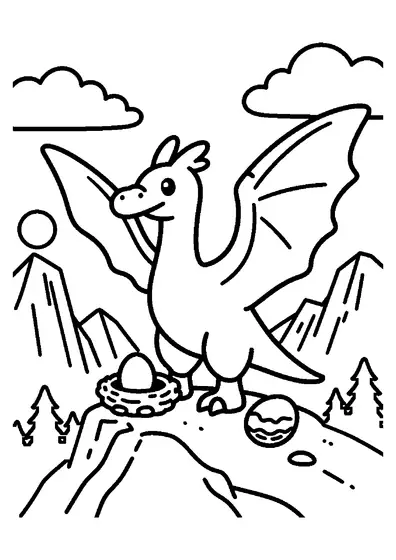
Pterodactyl Flying over a Deep Rocky Canyon
A flying pterosaur glides through the sky above a dramatic prehistoric canyon lined with steep rocky cliffs.

A4 format (landscape), black outlines on a white background · for home and classroom use
All coloring pages: Printable Coloring Pages for Kids
Similar coloring pages: Printable Coloring Pages for Kids

What else can you print? Free, no account needed
Custom Name Coloring Pages
Enter your child's name to generate a custom coloring page featuring large outline letters to color and decorate.
Open generator →Connect the Dots Generator
Eight connect-the-dots pictures across three difficulty levels. Features faint outline guides for younger children and dots only for older kids.
Open generator →Printables
Worksheets, tracing lines, mazes and dot-to-dots in A4.
Browse printables →
Pterodactyl Soaring Above a Rocky Canyon
This prehistoric scene depicts a flying reptile gliding over a vast canyon landscape. Steep cliffs and rocky terrain define the canyon floor below, illustrating the natural aerial territory of flying reptiles during the Mesozoic Era.
Flight Dynamics of Ancient Pterosaurs
Pterodactyls and related pterosaurs were the first vertebrates known to have evolved powered flight. Utilizing lightweight, hollow bones and expansive wing membranes supported by an elongated fourth finger, these creatures caught rising thermal air currents to soar effortlessly over deep gorges and coastal cliffs.
Authentic Colors of Pterosaurs and Canyon Rock Formations
- Pterodactyl wing membrane: Leathery tan, muted brown, or dark maroon
- Crest and body skin: Olive green, slate gray, or ruddy earth tones
- Canyon rock cliffs: Terracotta red, burnt orange, and layered sandstone tan
- Canyon floor shadows: Deep purple-gray and dark charcoal rock shades
- Prehistoric sky: Pale blue, dusty golden yellow, or twilight orange