
Stegosaurus Dinosaur in a Prehistoric Forest Clearing
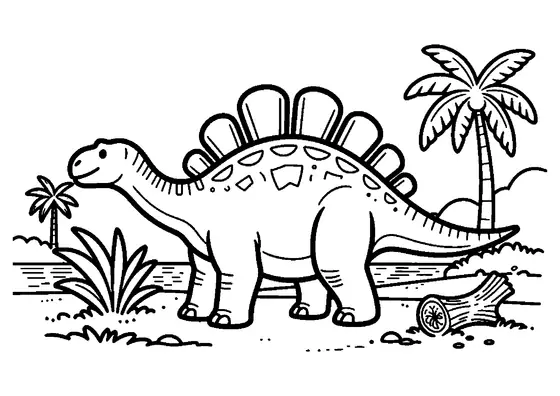
A stegosaurus stands surrounded by lush ancient plants in a quiet prehistoric forest setting.

A4 format (portrait), black outlines on a white background · for home and classroom use
All coloring pages: Printable Coloring Pages for Kids
Similar coloring pages: Printable Coloring Pages for Kids


What else can you print? Free, no account needed
Custom Name Coloring Pages
Enter your child's name to generate a custom coloring page featuring large outline letters to color and decorate.
Open generator →Connect the Dots Generator
Eight connect-the-dots pictures across three difficulty levels. Features faint outline guides for younger children and dots only for older kids.
Open generator →Printables
Worksheets, tracing lines, mazes and dot-to-dots in A4.
Browse printables →
Stegosaurus in the Prehistoric Forest
This scene depicts a stegosaurus surrounded by ancient plants and tall trees within a dinosaur habitat. The creature features iconic large bony plates along its spine and a spiky tail in a natural woodland environment.
Interesting Facts About Stegosaurus
Despite its massive body size, a stegosaurus had a remarkably tiny brain roughly the size of a walnut. The large plates on its back were not attached to its skeleton, but embedded directly into its tough hide. These dinosaurs relied on their heavy spiked tails, called thagomizers, to defend themselves against larger predators in dense prehistoric forests.
Real Colors of a Stegosaurus and Its Environment
- Stegosaurus skin: Natural shades of olive green, brownish gray, or dusty tan to blend into woodland foliage
- Back plates: Dark brown, muted reddish orange, or olive gray, which scientists believe helped regulate body temperature
- Tail spikes: Off-white or pale gray resembling dense bone
- Ancient plants and conifers: Deep green, brownish green, and dark rust tones typical of prehistoric vegetation