
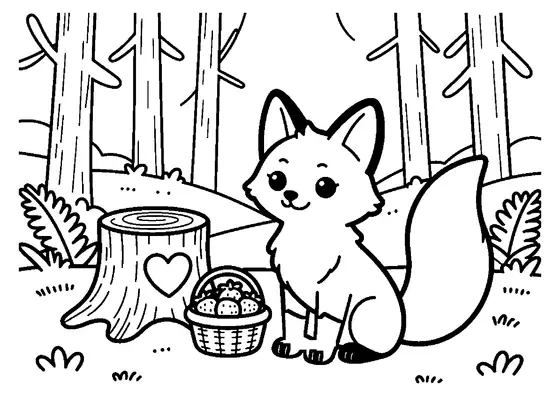
Fox in a Forest Clearing by a Heart-Shaped Root
A wild fox rests on a quiet woodland path beside a mature tree trunk featuring a heart-shaped hollow and a small basket.

A4 format (landscape), black outlines on a white background · for home and classroom use
All coloring pages: Valentine's Day Coloring Pages
Similar coloring pages: Valentine's Day Coloring Pages


What else can you print? Free, no account needed
Custom Name Coloring Pages
Enter your child's name to generate a custom coloring page featuring large outline letters to color and decorate.
Open generator →Connect the Dots Generator
Eight connect-the-dots pictures across three difficulty levels. Features faint outline guides for younger children and dots only for older kids.
Open generator →Printables
Worksheets, tracing lines, mazes and dot-to-dots in A4.
Browse printables →
A Wild Fox in the Autumn Clearing
A natural woodland scene captures a red fox seated along a narrow forest path. Beside the animal stands an old tree trunk with a distinct heart-shaped hollow near its root base, along with a small basket filled with fallen pinecones. Fallen leaves and rustic forest elements surround the peaceful clearing in a quiet wilderness setting.
Knowledge About Woodland Foxes and Pinecones
Red foxes rely on their bushy tails, known as brushes, for balance while running and to wrap around their bodies for warmth during chilly weather. Tree trunks develop hollows when fungal organisms or old branch breaks decay inner wood over decades without harming the outer living bark. Conifer trees produce pinecones to protect their seeds, closing their scales tightly during rain and opening them in dry sunshine.
Realistic Shades of the Forest Environment
- Fox coat: Fiery rusty orange, deep reddish auburn, white chest, and black lower legs
- Tree trunk and heart root: Dark oak bark brown, mossy green gray, or deep umber
- Pinecones: Warm chestnut brown, dark tan, or weathered grayish brown
- Woodland path soil: Earthy brown, damp leaf mold black, or sandy tan
- Forest basket: Woven brown rattan, dried willow straw, or dark hazel wood