
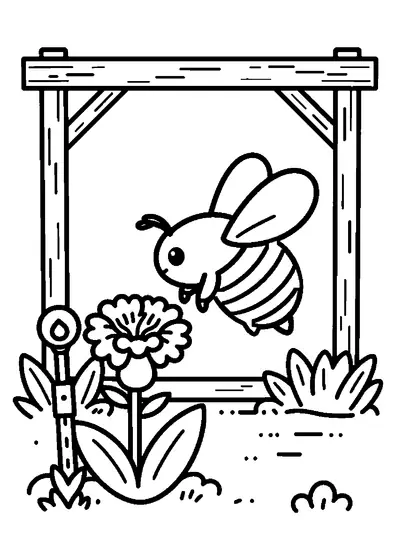
Bumblebee Landing on a Yellow Buttercup
A fuzzy bumblebee flies toward the shiny yellow petals of a wild buttercup growing in a sunny meadow.

A4 format (portrait), black outlines on a white background · for home and classroom use
All coloring pages: Flower Meadow Coloring Pages
Similar coloring pages: Flower Meadow Coloring Pages



What else can you print? Free, no account needed
Custom Name Coloring Pages
Enter your child's name to generate a custom coloring page featuring large outline letters to color and decorate.
Open generator →Connect the Dots Generator
Eight connect-the-dots pictures across three difficulty levels. Features faint outline guides for younger children and dots only for older kids.
Open generator →Printables
Worksheets, tracing lines, mazes and dot-to-dots in A4.
Browse printables →
A Fluffy Bumblebee Visiting a Meadow Buttercup
Buttercups are bright wild flowers that cover summer pastures with glossy yellow blooms. Their reflective petals catch the attention of busy bumblebees searching for sweet nectar and pollen. These hardworking pollinators hop from stem to stem, playing an essential role in keeping wild flower meadows healthy and abundant.
Surprising Facts About Bumblebees and Buttercups
Buttercup petals have a special layer of surface cells with air spaces underneath that reflects sunlight, giving them a mirror-like shine. Bumblebees can flap their wings over two hundred times per second, creating their characteristic low buzzing sound. Unlike honeybees, bumblebees can regulate their internal temperature, allowing them to fly in cooler weather early in the morning.
Natural Colors of the Bumblebee and Buttercup
- Bumblebee fur: jet black with bright yellow abdominal stripes
- Bumblebee wings: translucent smoky gray or pale brown
- Buttercup petals: glossy sunny yellow
- Buttercup flower center: small yellowish-green carpels
- Buttercup stem and leaves: vibrant grass green