
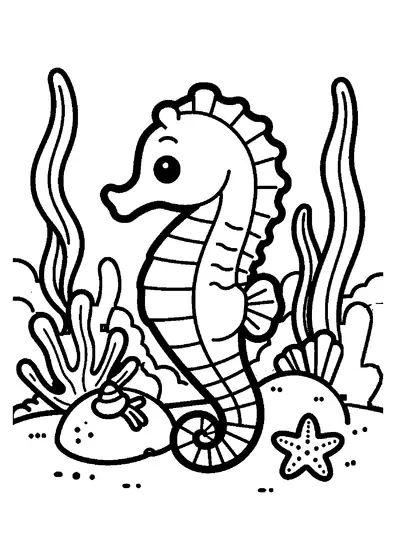
Seahorse in a Garden of Tube Anemones
A marine scene highlights a seahorse resting near slender tube anemones and a large ocean shell.

A4 format (portrait), black outlines on a white background · for home and classroom use
All coloring pages: Mermaid Coloring Pages
Similar coloring pages: Mermaid Coloring Pages


What else can you print? Free, no account needed
Custom Name Coloring Pages
Enter your child's name to generate a custom coloring page featuring large outline letters to color and decorate.
Open generator →Connect the Dots Generator
Eight connect-the-dots pictures across three difficulty levels. Features faint outline guides for younger children and dots only for older kids.
Open generator →Printables
Worksheets, tracing lines, mazes and dot-to-dots in A4.
Browse printables →
Marine Life Near Tube Anemones
Seahorses inhabit shallow coastal waters where soft ocean currents drift over sandy seabeds. In these marine environments, tube anemones anchor themselves into the seafloor while ocean shells rest along the sand.
Marine Survival and Habitat Facts
Tube anemones construct soft protective tubes by secreting mucus mixed with sand grains and mud. Unlike true sea anemones, tube anemones can completely retract their tentacles inside these tubes when danger approaches. Seahorses often rely on nearby marine plants and stationary sea life to stay anchored against moving water.
Natural Colors of Reef Inhabitants
- Seahorse body: Yellow, orange, brown, or speckled gray to match surrounding reefs
- Seahorse eyes: Dark brown or black with iridescent rings
- Tube anemones: Bright purple, fluorescent green, pink, or translucent cream
- Anemone tentacles: White, lavender, or light yellow
- Conch shell: Soft pink interior with beige and brown outer ridges