
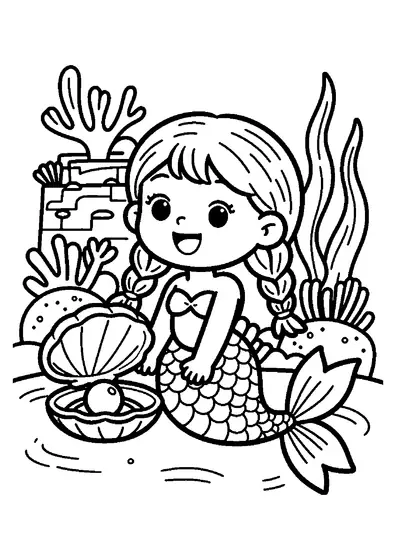
Mermaid Resting on a Coral Ledge
A seated mermaid relaxes on an elevated coral ledge beside a round sea urchin shell and a small ocean chest.

A4 format (portrait), black outlines on a white background · for home and classroom use
All coloring pages: Mermaid Coloring Pages
Similar coloring pages: Mermaid Coloring Pages


What else can you print? Free, no account needed
Custom Name Coloring Pages
Enter your child's name to generate a custom coloring page featuring large outline letters to color and decorate.
Open generator →Connect the Dots Generator
Eight connect-the-dots pictures across three difficulty levels. Features faint outline guides for younger children and dots only for older kids.
Open generator →Printables
Worksheets, tracing lines, mazes and dot-to-dots in A4.
Browse printables →
A Quiet Moment on a Coral Ledge
In this ocean setting, a mermaid sits peacefully atop a natural coral formation. Beside her rests a spherical sea urchin along with a small underwater chest perched securely on the rocky seafloor ledge.
Sea Urchins and Their Hard Spherical Shells
Sea urchins are spiny marine animals related to starfish that protect their soft inner bodies with a hard round shell called a test. When a sea urchin dies, its sharp protective spines fall away, leaving behind a patterned, hollow dome on the seabed.
Natural Colors of Sea Urchins and Coral Formations
- Sea urchin shell: lavender, dark purple, olive green, or reddish brown
- Coral ledge: pale pink, golden orange, and grayish beige
- Underwater wooden chest: rich mahogany, dark brown, with tarnished brass corners