
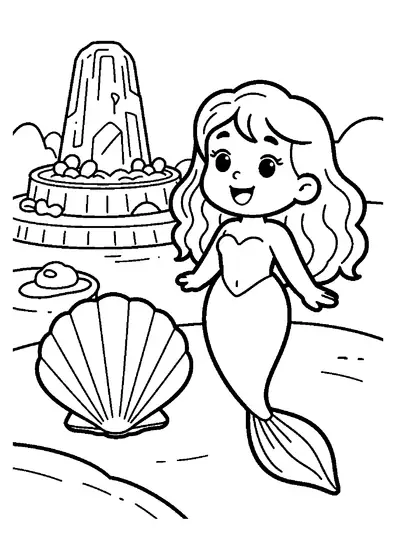
Mermaid on a Reef Terrace
A peaceful marine setting displays a seated mermaid resting on a stepped reef terrace beside a fan-shaped scallop shell and soft corals.

A4 format (landscape), black outlines on a white background · for home and classroom use
All coloring pages: Mermaid Coloring Pages
Similar coloring pages: Mermaid Coloring Pages


What else can you print? Free, no account needed
Custom Name Coloring Pages
Enter your child's name to generate a custom coloring page featuring large outline letters to color and decorate.
Open generator →Connect the Dots Generator
Eight connect-the-dots pictures across three difficulty levels. Features faint outline guides for younger children and dots only for older kids.
Open generator →Printables
Worksheets, tracing lines, mazes and dot-to-dots in A4.
Browse printables →
Terraced Coral Formations and Sea Life
This marine view shows a mermaid positioned on a terraced ocean reef structure surrounded by delicate soft coral colonies. Natural rock steps create distinct underwater levels, providing a resting place next to a ribbed scallop seashell embedded along the reef edge.
Structure of Coral Terraces and Soft Corals
Coral reef terraces are formed over centuries through a combination of sea level changes, wave erosion, and continuous coral growth. Unlike hard stony corals, soft corals lack rigid calcium skeletons and instead flex gently with tidal currents. These flexible organisms form vibrant underwater gardens on rocky underwater ledges and shelf formations.
Colors of Living Coral Reefs
- Soft corals: pastel lavender, rose pink, bright yellow, and warm orange
- Scallop shell: reddish brown, cream, fan-patterned beige, and pale pink
- Reef terrace rocks: dusty gray, sandy tan, and dark seaweed green
- Mermaid scales: iridescent seafoam green, ocean blue, and silver