
Mermaid Making Shell Beads at a Sandy Table
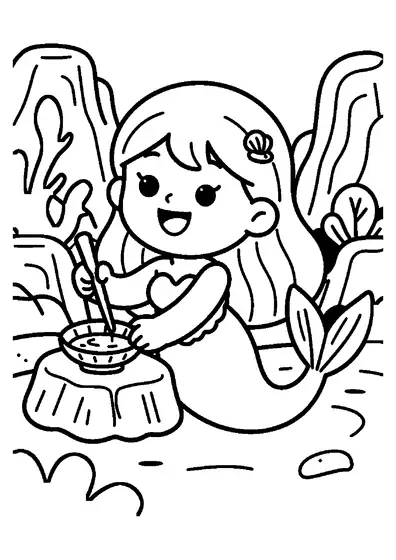
A serene subsea illustration features a mermaid crafting shell beads at a stone table.

A4 format (landscape), black outlines on a white background · for home and classroom use
All coloring pages: Mermaid Coloring Pages
Similar coloring pages: Mermaid Coloring Pages



What else can you print? Free, no account needed
Custom Name Coloring Pages
Enter your child's name to generate a custom coloring page featuring large outline letters to color and decorate.
Open generator →Connect the Dots Generator
Eight connect-the-dots pictures across three difficulty levels. Features faint outline guides for younger children and dots only for older kids.
Open generator →Printables
Worksheets, tracing lines, mazes and dot-to-dots in A4.
Browse printables →
Threading Shell Beads Beneath the Waves
Beneath the ocean surface, a mermaid sits at a stone table to arrange and thread small shell beads. The calm seabed setting surrounds her crafting activity.
Ocean Shells and Ancient Crafts
Humans and coastal cultures have used sea shells to create beads and jewelry for over one hundred thousand years. Tiny mollusks produce shells made of calcium carbonate, creating distinct spiral patterns and natural perforations. Shell beads remain among the oldest known forms of personal ornamentation in human history.
Natural Tones of Shells and Stone
- Shell beads: Pearl white, soft rose, cream, or iridescent mother-of-pearl.
- Stone table: Sandstone beige, light granite gray, or smooth pebble gray.
- Mermaid tail: Royal blue, jade green, or sea-crystal teal.
- Seabed floor: Warm sand gold or light tan sediment.