
Weaver at Rug Loom
A smiling artisan works beside a large wooden loom set up in a sunlit weaving studio lined with shelves.

A4 format (landscape), black outlines on a white background · for home and classroom use
All coloring pages: Jobs and Professions Coloring Pages
Similar coloring pages: Jobs and Professions Coloring Pages

What else can you print? Free, no account needed
Custom Name Coloring Pages
Enter your child's name to generate a custom coloring page featuring large outline letters to color and decorate.
Open generator →Connect the Dots Generator
Eight connect-the-dots pictures across three difficulty levels. Features faint outline guides for younger children and dots only for older kids.
Open generator →Printables
Worksheets, tracing lines, mazes and dot-to-dots in A4.
Browse printables →
Traditional Rug Loom in a Handweaver Workshop
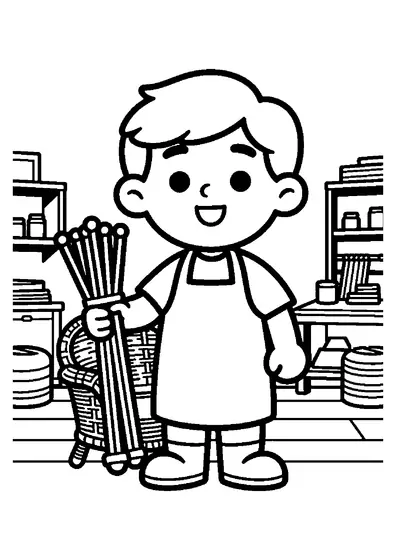
In this studio setting, a weaver stands beside a carpet loom holding spun yarn stored in a nearby basket, with storage shelves lining the bright workspace wall.
Interesting Facts About Weaving and Looms
Hand weaving relies on warp threads stretched tight across a loom while weft threads pass horizontally between them to construct fabric. Traditional weavers often spin natural fibers like sheep wool or cotton before winding them into skeins for rug production. Manual textile workshops utilize vertical frame looms to maintain heavy thread tension required for thick carpets.
Natural Colors of a Weaving Studio
- Frame loom: rich brown or natural pine timber
- Spun yarn skeins: dyed crimson, cobalt blue, or golden yellow
- Studio shelves: light birch wood or whitewashed timber
- Woven carpet fibers: off-white wool or muted earth tones