
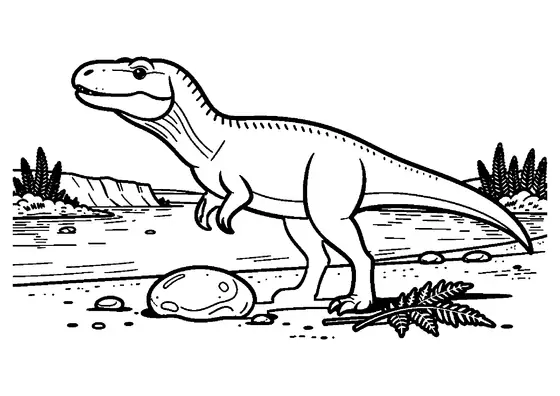
Iguanodon in a Grove of Ginkgo Trees
An Iguanodon explores prehistoric fruit beneath the fan-shaped foliage of an ancient ginkgo grove.

A4 format (landscape), black outlines on a white background · for home and classroom use
All coloring pages: Dinosaur Coloring Pages
Similar coloring pages: Dinosaur Coloring Pages


What else can you print? Free, no account needed
Custom Name Coloring Pages
Enter your child's name to generate a custom coloring page featuring large outline letters to color and decorate.
Open generator →Connect the Dots Generator
Eight connect-the-dots pictures across three difficulty levels. Features faint outline guides for younger children and dots only for older kids.
Open generator →Printables
Worksheets, tracing lines, mazes and dot-to-dots in A4.
Browse printables →
The Iguanodon in its leafy grove
This plant-eating dinosaur moves among ginkgo trees and prehistoric fruit, with the grove forming the setting around it. Iguanodon is recognized by the prominent spike on each thumb, along with a beak at the front of its mouth and rows of teeth farther back. Its sturdy limbs could support different kinds of movement as it traveled and fed.
Lesser-known facts about feeding in a grove
Iguanodon had complex teeth that wore against one another and helped process tough plant matter. Its beak could crop vegetation before the food passed to the teeth at the sides of the jaw. Ginkgo seeds have fleshy outer coverings that may look like fruit, but botanically they are seeds rather than true fruits.
Colors found in nature
- Iguanodon skin: not known from direct color evidence; brown, olive, or gray are cautious natural choices
- Thumb spikes: the living outer covering may have been pale tan, brown, or gray, but its color is unknown
- Ginkgo leaves: fresh green in season, changing to vivid yellow in fall
- Ginkgo trunks and branches: gray-brown to brown
- Ginkgo seed coverings: yellow to orange when mature