
Triceratops by a Forest Stream
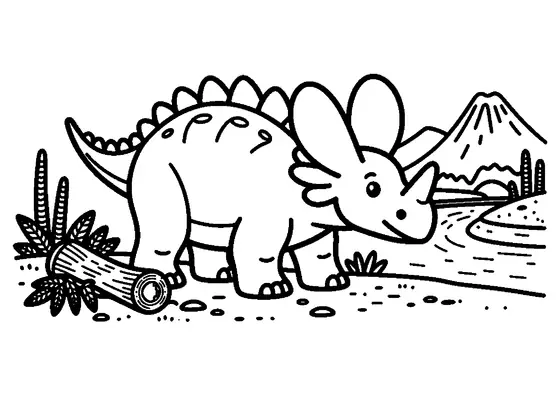
This page depicts an ancient triceratops standing beside a flowing stream in a prehistoric forest.

A4 format (landscape), black outlines on a white background · for home and classroom use
All coloring pages: Herbivorous Dinosaur Coloring Pages
Similar coloring pages: Herbivorous Dinosaur Coloring Pages



What else can you print? Free, no account needed
Custom Name Coloring Pages
Enter your child's name to generate a custom coloring page featuring large outline letters to color and decorate.
Open generator →Connect the Dots Generator
Eight connect-the-dots pictures across three difficulty levels. Features faint outline guides for younger children and dots only for older kids.
Open generator →Printables
Worksheets, tracing lines, mazes and dot-to-dots in A4.
Browse printables →
Triceratops in a Prehistoric Forest
A triceratops stands along the edge of a quiet stream running through a dense prehistoric forest. The herbivore features a broad neck frill and facial horns as it pauses near the water.
Prehistoric Forest Streams
During the Late Cretaceous period, coastal floodplains and forest basins contained active river systems that nourished thick plant growth. Freshwater streams supported diverse ecosystems where large plant-eating dinosaurs found food and water.
Natural Colors of the Triceratops and Its Environment
- Triceratops skin: muted gray, brown, or earthy green
- Neck frill and horns: off-white, light tan, or dark gray
- Forest stream water: clear blue, teal, or soft gray
- Surrounding trees: deep green, yellow-green, and dark brown