
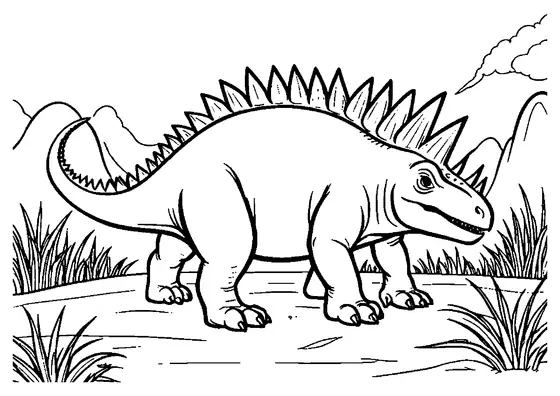
Scelidosaurus Standing by the Grass
An armored Scelidosaurus rests on all four legs beside low patches of vegetation on an open plain.

A4 format (landscape), black outlines on a white background · for home and classroom use
All coloring pages: Herbivorous Dinosaur Coloring Pages
Similar coloring pages: Herbivorous Dinosaur Coloring Pages


What else can you print? Free, no account needed
Custom Name Coloring Pages
Enter your child's name to generate a custom coloring page featuring large outline letters to color and decorate.
Open generator →Connect the Dots Generator
Eight connect-the-dots pictures across three difficulty levels. Features faint outline guides for younger children and dots only for older kids.
Open generator →Printables
Worksheets, tracing lines, mazes and dot-to-dots in A4.
Browse printables →
An Armored Scelidosaurus Beside Ground Vegetation
This side-profile illustration shows a four-legged Scelidosaurus positioned on a flat ground line. Rows of protective bony plates align along the dinosaur's back and sides as it stands motionless next to small tufts of grass.
The Early History of Armored Dinosaurs
Scelidosaurus lived during the Early Jurassic period and is one of the earliest complete armored dinosaurs discovered by paleontologists. Unlike later massive armored species, Scelidosaurus was relatively lightweight, relying on rows of small stud-like bony scutes embedded in its skin to deter predators while feeding on low-growing ferns and primitive grasses.
Realistic Colors of Early Jurassic Dinosaurs
- Scelidosaurus hide: Earthy olive green, dull brown, or mottled gray for camouflage in foliage
- Armor plates: Dark charcoal gray, bone white, or tan with weathered textures
- Ground vegetation: Deep forest green, yellowish green, or dried brownish gold
- Soil and terrain: Rich reddish brown, dark clay gray, or dusty beige