
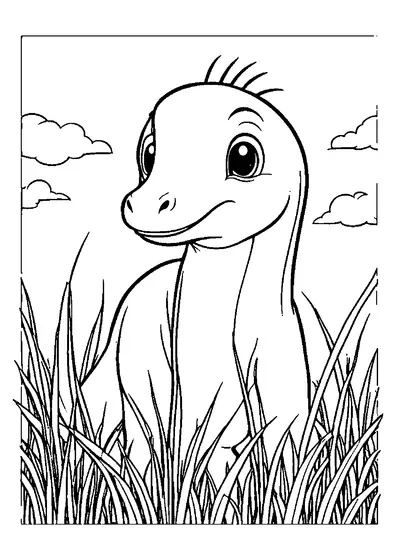
Armored Pinacosaurus in Thick Grass
An armored Pinacosaurus stands amid clumps of tall grass, with small pebbles scattered across the ground.

A4 format (portrait), black outlines on a white background · for home and classroom use
All coloring pages: Herbivorous Dinosaur Coloring Pages
Similar coloring pages: Herbivorous Dinosaur Coloring Pages


What else can you print? Free, no account needed
Custom Name Coloring Pages
Enter your child's name to generate a custom coloring page featuring large outline letters to color and decorate.
Open generator →Connect the Dots Generator
Eight connect-the-dots pictures across three difficulty levels. Features faint outline guides for younger children and dots only for older kids.
Open generator →Printables
Worksheets, tracing lines, mazes and dot-to-dots in A4.
Browse printables →
What appears around the armored Pinacosaurus
The smiling Pinacosaurus stands on four legs among dense patches of high grass. Armor covers its broad body, and pointed features run along its back and head. A few small pebbles lie beneath it, while the area above the dinosaur remains open and keeps attention on its protective body covering.
Interesting facts about Pinacosaurus and its habitat
Pinacosaurus was an ankylosaur, a group of plant-eating dinosaurs protected by bony plates embedded in the skin. Fossils of this dinosaur have been found in parts of Asia that once contained dry landscapes where plants often grew near available water. Its low head was well suited to feeding on vegetation close to the ground.
Real-world colors of the subjects
- Pinacosaurus skin: the exact color is unknown; earthy brown, sandy tan, olive, or muted gray are plausible
- Bony armor: unknown, but it may have blended with or contrasted against the surrounding skin
- Back spikes: exact colors are unknown and can reasonably follow the armor palette
- Tall grass: green during active growth or straw yellow and brown when dry
- Pebbles: commonly gray, tan, brown, rust red, or nearly black