
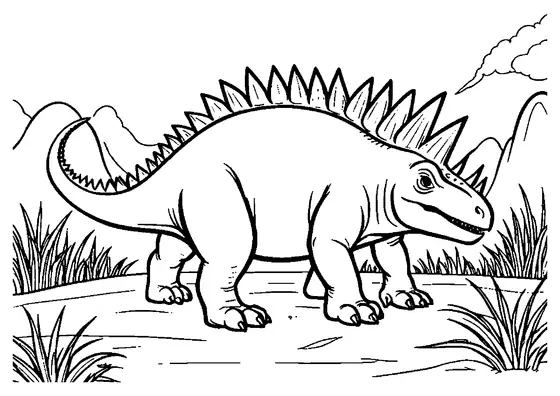
Nodosaurus Standing in Tall Grass
A sturdy Nodosaurus stands firmly on four heavy legs, displaying its impressive armor plates across its broad back.

A4 format (landscape), black outlines on a white background · for home and classroom use
All coloring pages: Herbivorous Dinosaur Coloring Pages
Similar coloring pages: Herbivorous Dinosaur Coloring Pages


What else can you print? Free, no account needed
Custom Name Coloring Pages
Enter your child's name to generate a custom coloring page featuring large outline letters to color and decorate.
Open generator →Connect the Dots Generator
Eight connect-the-dots pictures across three difficulty levels. Features faint outline guides for younger children and dots only for older kids.
Open generator →Printables
Worksheets, tracing lines, mazes and dot-to-dots in A4.
Browse printables →
Nodosaurus in Standing Pose
A solitary Nodosaurus stands positioned on all four sturdy legs. Rows of thick, protective bony plates cover its entire back and upper sides, extending from its neck down to its tail. The quadruped herbivore keeps its head held close to the ground in a steady resting posture.
Armor Structure of Nodosaurus
Nodosaurus was one of the first armored dinosaurs discovered in North America, giving its name to the nodosaurid family. Its back was covered with alternating bands of large and small bony knobs, called osteoderms, embedded directly into its tough skin. Lacking a tail club, it relied on hunkering down close to the soil to defend its vulnerable underside from attackers.
Natural Colors of Nodosaurus
- Bony back plates: Dark earth brown or muted ochre tones
- Side skin folds: Dusty gray or yellowish-tan hide
- Underbelly: Lighter cream or soft beige color
- Claws and beak: Pale bone gray or horn-colored shading