
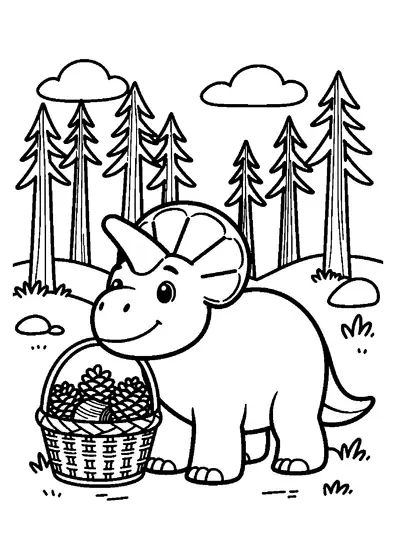
Eotriceratops next to a Wooden Rake
A prehistoric Eotriceratops stands beside a tall wooden rake in an open forest meadow surrounded by trees.

A4 format (landscape), black outlines on a white background · for home and classroom use
All coloring pages: Herbivorous Dinosaur Coloring Pages
Similar coloring pages: Herbivorous Dinosaur Coloring Pages



What else can you print? Free, no account needed
Custom Name Coloring Pages
Enter your child's name to generate a custom coloring page featuring large outline letters to color and decorate.
Open generator →Connect the Dots Generator
Eight connect-the-dots pictures across three difficulty levels. Features faint outline guides for younger children and dots only for older kids.
Open generator →Printables
Worksheets, tracing lines, mazes and dot-to-dots in A4.
Browse printables →
Eotriceratops in a Woodland Meadow
A large Eotriceratops stands calmly near a wooden garden rake. The meadow opens up into a woodland backdrop that extends across the surrounding landscape.
Facts About Eotriceratops and Woodworking Tools
Eotriceratops was one of the largest horned dinosaurs, featuring massive head horns that measured over three feet in length. Wooden rakes were traditionally crafted from durable hardwoods like ash or beech to handle heavy clearing work in fields and garden spaces. Combining ancient ceratopsians with traditional hand tools offers a creative look at prehistoric scale alongside human craftsmanship.
Realistic Colors for Eotriceratops and Forest Elements
- Eotriceratops skin: Dusty brown, tan, or dark slate gray
- Horns and beak: Weathered bone white or gray
- Wooden rake handle and teeth: Natural timber beige or light oak brown
- Forest meadow grass: Vibrant green, yellow-green, or olive
- Woodland trees: Forest green foliage with dark brown bark