
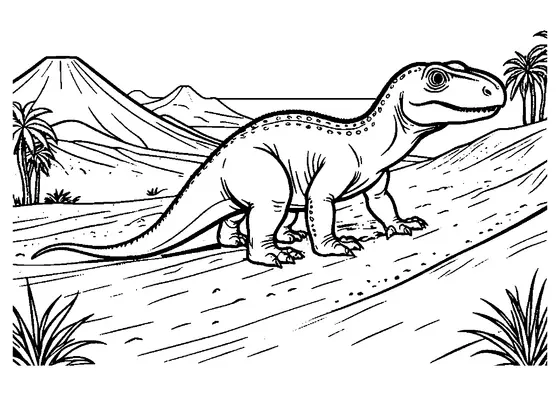
Dinosaur Beside a Cracked Egg
A friendly four-legged dinosaur examines a large cracked egg resting among grass and small stones.

A4 format (landscape), black outlines on a white background · for home and classroom use
All coloring pages: Herbivorous Dinosaur Coloring Pages
Similar coloring pages: Herbivorous Dinosaur Coloring Pages


What else can you print? Free, no account needed
Custom Name Coloring Pages
Enter your child's name to generate a custom coloring page featuring large outline letters to color and decorate.
Open generator →Connect the Dots Generator
Eight connect-the-dots pictures across three difficulty levels. Features faint outline guides for younger children and dots only for older kids.
Open generator →Printables
Worksheets, tracing lines, mazes and dot-to-dots in A4.
Browse printables →
What is happening beside the cracked egg
The dinosaur stands at the center of the scene next to the broken shell. Clumps of grass and scattered pebbles surround the pair in the foreground and background. The close placement of the animal and egg creates a gentle moment of curiosity about how prehistoric young began life.
Fascinating facts about dinosaur eggs
Dinosaurs laid eggs, and many species built nests or selected nesting areas where eggs could develop. Paleontologists have found fossil eggs, nests, embryos, and even groups of nests close together. A cracked fossil shell can reveal its structure, but it does not always show whether a baby hatched successfully or the egg was damaged later.
Colors from the natural world
- Dinosaur skin: the exact color depends on the unknown species; earthy green, brown, or gray are plausible
- Dinosaur eyes: dark brown or black
- Eggshell: fossil and modern reptile eggs suggest cream, tan, pale gray, or muted blue-green possibilities
- Grass: green, straw yellow, or dry brown
- Pebbles: gray, beige, brown, rust, or charcoal