
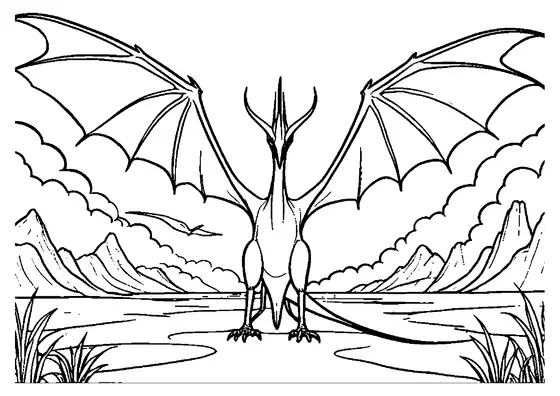
Quetzalcoatlus Resting Beside a Fern
A towering Quetzalcoatlus stands on its long legs among broad fern leaves in a prehistoric setting.

A4 format (portrait), black outlines on a white background · for home and classroom use
All coloring pages: Flying and Sea Reptile Coloring Pages
Similar coloring pages: Flying and Sea Reptile Coloring Pages


What else can you print? Free, no account needed
Custom Name Coloring Pages
Enter your child's name to generate a custom coloring page featuring large outline letters to color and decorate.
Open generator →Connect the Dots Generator
Eight connect-the-dots pictures across three difficulty levels. Features faint outline guides for younger children and dots only for older kids.
Open generator →Printables
Worksheets, tracing lines, mazes and dot-to-dots in A4.
Browse printables →
What the Quetzalcoatlus scene shows
The flying reptile is shown upright beside a large fern, with its long neck, pointed beak, folded body, and tall legs forming the central subject. Broad fronds surround the animal and establish the ancient environment. Quetzalcoatlus was an azhdarchid pterosaur rather than a dinosaur, although it lived during the age of dinosaurs.
Surprising facts about Quetzalcoatlus and its habitat
Scientists think azhdarchids spent considerable time moving on the ground, where their long limbs could help them search for food. Ferns are an ancient group of plants that reproduce through spores instead of flowers or seeds. The exact feeding habits of Quetzalcoatlus remain uncertain, but researchers have proposed that it gathered small animals and other food from the ground.
Real-world colors for Quetzalcoatlus and the fern
- Quetzalcoatlus body: unknown, because fossils do not reveal its complete natural coloring
- Wing membranes: possibly muted brown, tan, or gray, though their actual color is not known
- Long beak: an uncertain natural shade, with earthy gray or brown as a plausible interpretation
- Fern fronds: usually fresh green, deep green, or yellow-green
- Fern stems: commonly green, reddish brown, or brown